
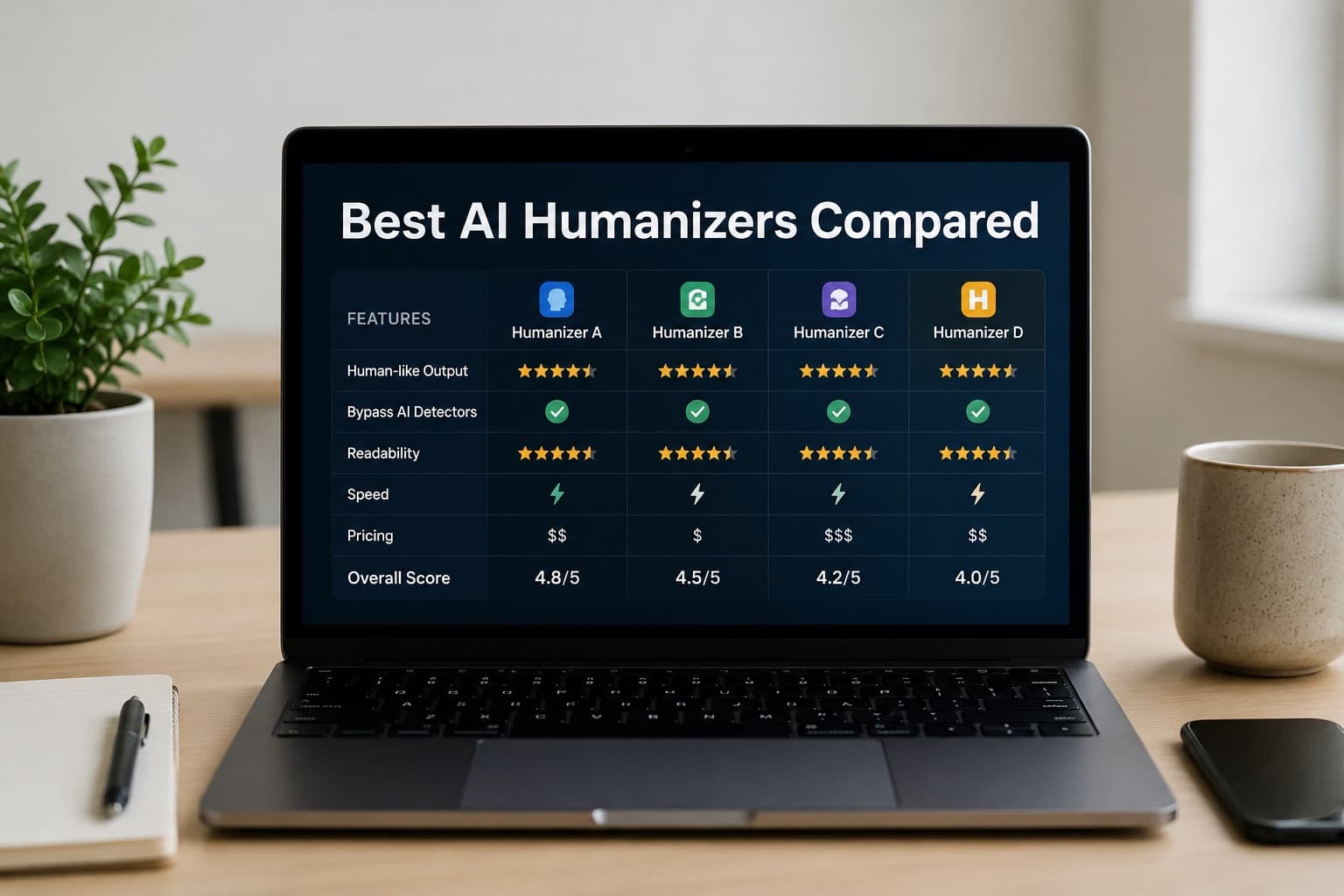
Best AI Humanizers Compared (2026): Human Writes vs QuillBot, Undetectable AI, and StealthWriter
An honest comparison of Human Writes, QuillBot, Undetectable AI, StealthWriter and Grammarly: what each does, what it costs, and which suits your work.
You asked ChatGPT for a draft, it came back clean and confident, and it sounds exactly like ChatGPT. That gap between "reads fine" and "reads like a person" is what AI humanizers promise to close. The market is crowded and loud, and most comparison pages are written by the tools themselves.
This one is too, so let's be upfront: we make Human Writes, and we'll tell you where we think it fits and where another tool is the better choice. We've focused on what each tool actually does rather than its marketing, and we've left out bypass-rate tables, because those numbers change every time a detector updates and say nothing about whether the writing is any good.
The quick comparison
| Tool | What it's really for | Starting price (late 2026) | Watch out for |
|---|---|---|---|
| Human Writes | Rewriting AI drafts into natural voice, keeping facts; strips invisible characters | Free 300 words; paid from $9.99/month | Not a detector bypass; works best when you add your own specifics |
| QuillBot | Paraphrasing, grammar and a humanizer in one student-friendly suite | Free tier; Premium from $8.33/month billed annually | Keeps much of the original structure |
| Grammarly | Writing assistant with AI Detector, AI Rewriter and Humanizer agents | Pro from $12/month billed annually | Its own detector is likely to flag its humanizer's output |
| Undetectable AI | Rewriting aimed squarely at lowering detector scores | From $9.99/month for 10,000 words | Marketing centred on evasion |
| StealthWriter | Similar evasion-focused rewriting with multiple output versions | From $20/month | Output quality varies; same evasion framing |
Human Writes
Human Writes is built for one job: taking an AI-assisted draft and rewriting it so it reads like a person wrote it, without losing the facts and meaning you've already checked. It also strips the invisible Unicode characters that often come along when you copy text from chat tools, and shows a built-in AI score so you can see which paragraphs still read as generic. When you humanize, the rewrite also breaks up the statistical watermarks Claude and ChatGPT now embed in their text, though no tool can certify those are fully gone, because the vendors keep their detectors private.
What it won't do is invent the specifics that make writing sound like you: the example from your class, the client's real numbers, your actual opinion. You'll get the best results by adding those yourself. And it can't guarantee any detector result; no tool can.
QuillBot
QuillBot is a writing suite best known for its paraphraser, with grammar checking, summarising, citations and, more recently, an AI humanizer and free AI detector. It's cheap, familiar to students, and good at producing alternative phrasings of a sentence. For polishing writing you mostly wrote yourself, it's often all you need.
Its limitation for AI drafts is structural. Paraphrasing tools vary the words while keeping the shape of the original: the same order of points, the same evenly paced sentences, the same generic examples. Readers and detectors notice that shape more than individual word choices. Paraphraser vs AI humanizer explains the difference.
Grammarly
Grammarly, now part of the company Superhuman, has added an AI Detector, an AI Rewriter and a Humanizer agent to its writing assistant. If you already pay for it, these are a convenient way to rework a paragraph without switching tools, and Grammarly's tone and clarity suggestions remain excellent. One honest caveat comes from Grammarly's own help pages: its Humanizer's output is generated by Grammarly's model, so its own AI Detector is likely to flag it. Our Grammarly guide goes into more detail.
Undetectable AI and StealthWriter
These two are the most visible tools that market themselves mainly on lowering AI detection scores. Both rewrite text more aggressively than a paraphraser, and both are popular with people whose priority is the score rather than the writing.
That framing is the main reason to be cautious. Turnitin added detection specifically aimed at humanizer and bypasser tools in 2025, and other detectors, including Pangram, now look for the same thing. A tool built to evade detection is in an arms race it can't permanently win, and the output can read oddly once it's been optimised for a score rather than a reader. If you're a student, using any tool to disguise AI work your course doesn't allow is an integrity breach whatever the number says. Our StealthWriter and Undetectable AI comparison looks at them in more depth.
How to choose
Start with what you're actually trying to fix. If your own writing needs polishing, a paraphraser or Grammarly is probably enough. If you have an AI draft that's factually right but sounds generic, you want a tool that rewrites properly and leaves your facts alone, and then you want to add your own material. If your main goal is a lower detector score, it's worth asking why, because if AI use is allowed, disclosure usually solves the problem, and if it isn't, no tool makes it allowed.
Whichever you pick, test it on a paragraph you know well before trusting it with something important. Check that facts, names, numbers and citations survived the rewrite. Read the result aloud. If it sounds like you, it's working.
Our verdict
No humanizer turns a generic draft into good writing on its own. The tools that help most are the ones that rewrite properly, keep your facts intact and leave you room to add what only you know. If that's what you're after, you can try Human Writes free on 300 words. For the detector side of the picture, see GPTZero vs other AI detectors.