
GPTZero for Teachers: Classroom Guide (Not a Student Bypass)
GPTZero in the classroom is a conversation starter for teachers—not a cheat code for students. How to use scores with due process, pair with process checks, and avoid false positives.
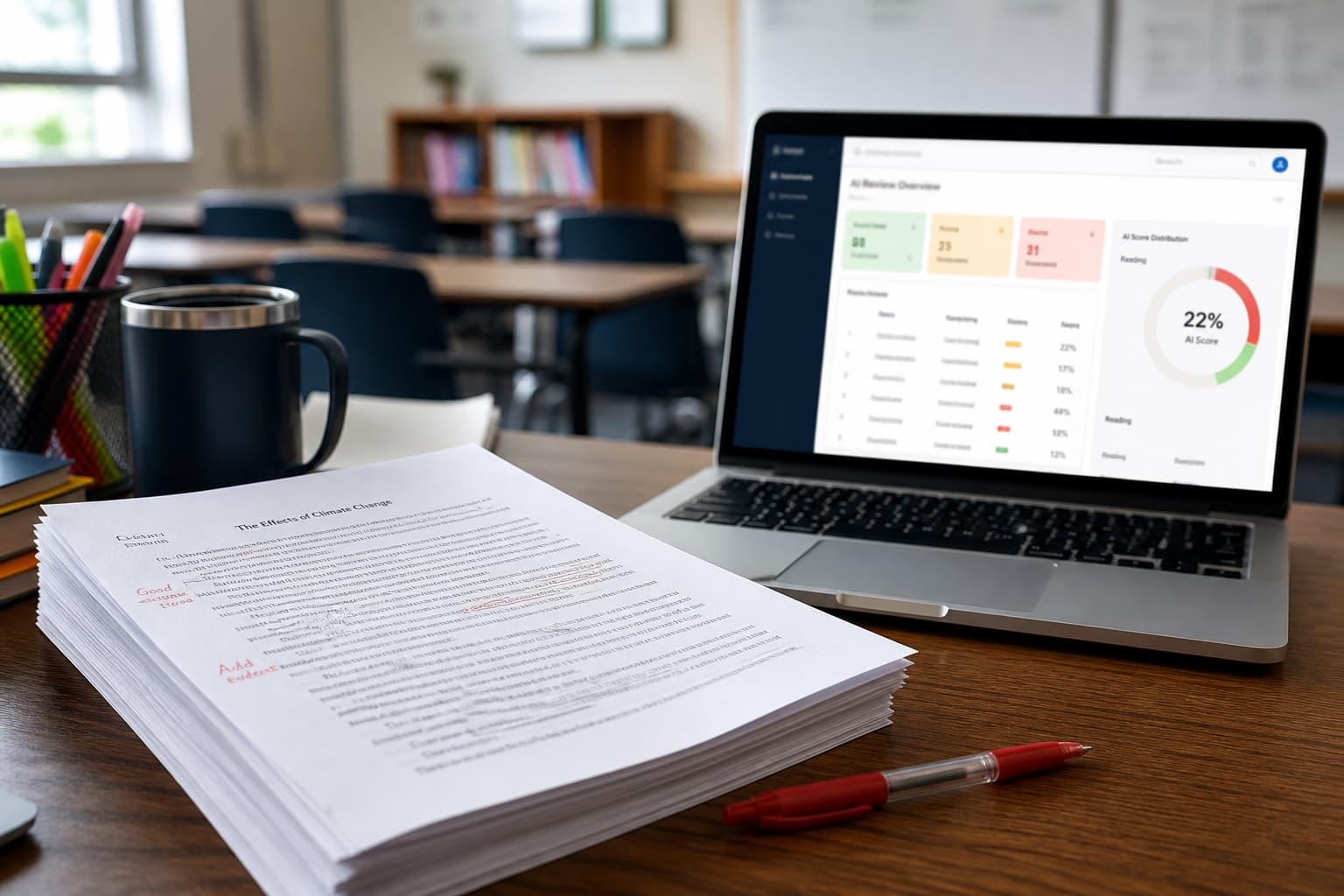
GPTZero is built for educators who need a fast signal, not for students shopping a bypass. In the classroom, it works best when you already teach writing as a process—and when you treat a score as the start of a conversation, not the end of a grade.
Used well, GPTZero highlights stiff spans you would have questioned anyway. Used badly, it becomes a percentage on a screen that punishes the wrong kid.
Related: can professors detect AI writing?, how teachers spot AI homework, does GPTZero save your work?.
What GPTZero is for in your classroom
| Good use | Poor use |
|---|---|
| Flagging a submission for follow-up | Auto-fail on score alone |
| Comparing sentence-level highlights to the rubric | Public shaming in front of class |
| Teaching what generic AI prose looks like | Replacing draft checkpoints |
| Pairing with oral defense or notes request | Ignoring false positives on ESL work |
| Documenting due process for admin | Arms race with humanizers |
This is an integrity workflow tool—not homework insurance for students.
Teacher workflow (due process first)
- Syllabus — State what AI is allowed (outline, grammar, none) and how you review suspected misuse.
- Process assignments — Outlines, annotated bibliographies, or in-class planning reduce pure paste submissions before you need a detector.
- Run GPTZero when you have other reasons — Voice shift, missing lecture detail, citation smell. See teacher homework checklist.
- Read highlights, not only the headline % — Which paragraphs triggered? Do they match stiff, source-free claims?
- Student conversation — Ask for drafts, notes, source PDFs, or a short oral summary of the thesis.
- Escalate with documentation — Score screenshot + your rubric notes + student response. Not a single number emailed to parents.
For what students face on the other side of that conversation, see can professors detect AI writing?.
GPTZero vs other classroom options
| Tool | Classroom fit | Caveat |
|---|---|---|
| GPTZero | Quick scan, sentence highlights, Google Classroom tie-ins | Stores text by default; noisy on short pieces |
| Turnitin | Institution-wide, LMS integrated | AI score ≠ similarity score; policy varies |
| Manual review | Often strongest signal | Time cost; train TAs on rubric |
| In-class writing | Baseline voice | Not always feasible |
Broader comparison: GPTZero vs other detectors. Accuracy context: AI detection accuracy.
Pairing GPTZero with writing instruction
Use detector highlights in a lesson, not only a punishment:
- Show anonymized stiff sentences and ask class to improve warrant or evidence.
- Compare AI-shaped text to a revision with class-specific detail.
- Assign a short in-class paragraph before a take-home essay to establish voice.
When students see why generic prose fails rubrics, they need fewer accusatory emails. Pair with natural writing techniques for revision habits.
False positives and fairness
Formal academic English, templates from prior years, and some multilingual writers can score high without ChatGPT. Before penalties:
- Compare to prior work from the same student
- Check whether the stiff spans are citation-free claims
- Offer process evidence request, not only accusation
- Know campus appeal steps
Share ESL false positives with colleagues when reviewing borderline cases.
What to tell students (transparent, not adversarial)
- Allowed AI uses are on the syllabus
- You may review work with software and process questions
- Scores are not proof alone
- Disclosure is required when stated
- Humanizers do not replace doing the reading
Point students to ethical AI use checklist—not detector evasion blogs.
Privacy and policy checklist
- Institutional contract or FERPA guidance reviewed
- Students know submissions may be stored on GPTZero servers
- Alternative for students who cannot upload (oral review, timed writing)
- Consistent process across sections
- Admin informed before first academic integrity case
Retention details: Does GPTZero Save Your Work?.
Bottom line
GPTZero belongs in a teacher integrity toolkit paired with rubrics, drafts, and conversation—not in a student playbook to chase zero. Use highlights to ask better questions; use policy to protect fair process.
For student-facing Q&A on detection and appeals, share can professors detect AI writing?.