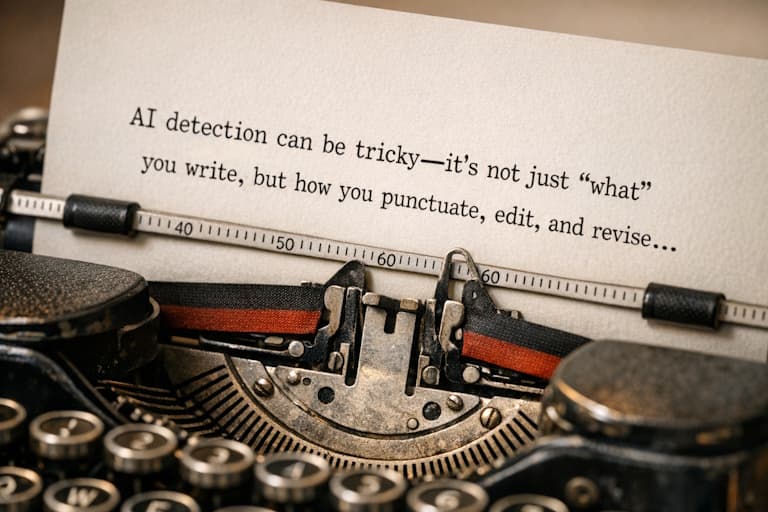
How Punctuation Impacts AI Detection
Discover how punctuation patterns reveal AI-generated text and learn strategies to adjust your writing for a more natural, human-like flow.
Punctuation can reveal whether text is human-written or AI-generated. AI detection tools analyze patterns like sentence structure, punctuation ratios, and flow. Human writing tends to have natural inconsistencies—mixing short and long sentences, varied punctuation, and minor errors. AI text, by contrast, often features uniform punctuation, "perfect" grammar, and predictable sentence lengths. Key red flags include:
- Overuse of em dashes: AI frequently uses these for polished pauses.
- Uniform punctuation: Predictable patterns like consistent colons or commas.
- Straight quotation marks: AI text lacks curly quotes often added by word processors.
- Flawless grammar: Lack of small human-like imperfections raises suspicion.
To avoid detection, introduce natural quirks: vary punctuation, include minor errors, and mix straight and curly quotes. Tools like Human Writes can help adjust punctuation and improve text flow, making machine-generated text appear more human-like.
How AI Detects Punctuation Patterns
AI detection systems don't just skim through your words—they dive deep, analyzing every comma, dash, and period with precision. These tools rely on stylometry, a branch of forensic linguistics that examines over 500 subtle writing markers to create a statistical "fingerprint" or "DNA" of your text. Think of it like a forensic lab, but instead of analyzing crime scene evidence, it's dissecting how you pause, connect ideas, and structure sentences.
Statistical Analysis of Punctuation Usage
Detection algorithms meticulously track punctuation ratios within your text. They examine how often commas appear, the ratio of semicolons to periods, and even the predictability of em dashes. Ejaz Ahmad from NetusAI explains it best:
Stylometry, the statistical engine behind AI-detection tools, analyzes your writing's rhythm, cadence and punctuation, not ideas or accuracy.
AI-generated text tends to display a uniform distribution of punctuation—everything looks neat and balanced. Human writing, however, is far less predictable. For instance, you might cram three commas into one sentence and then go five sentences without using any. Tools like Hastewire claim to achieve up to 99% accuracy in detecting AI-generated text in English by focusing on these linguistic fingerprints and evaluating sentence diversity. This intense scrutiny of punctuation patterns helps pinpoint irregularities that hint at machine authorship.
Detection of Unusual Patterns
Building on frequency analysis, AI detectors also look for syntactic uniformity—those perfectly balanced sentence structures that rarely occur in human writing. They scan for consistent formatting in bullet points, repetitive paragraph openers, and mechanical transitions where punctuation feels more like a placeholder than a natural pause in thought. If your text features medium-length sentences strung together with flawless punctuation, it raises suspicion. Researchers also highlight "structural repetition", where lists and formatting follow overly consistent patterns, as a telltale sign of AI involvement.
Fluency Metrics and Human-Like Errors
Detection systems don't just count punctuation marks—they also assess how naturally the text flows. Here's the twist: AI detectors often flag text that's "too perfect." Writing with flawless grammar and sterile punctuation can come across as synthetic. As the Skylineacademic Team puts it:
A completely sterile piece with no quirks at all can look suspicious. The aim is high quality with a natural level of individual style, not machine perfection.
These systems measure perplexity (how "surprised" the algorithm is by your word and punctuation choices) and burstiness (the variation in sentence structure). Human writing typically scores high on both because we naturally include fragments, unexpected comma placements, and pauses that feel spontaneous. Ironically, relying too heavily on grammar correction tools can backfire. Over-corrected text often loses the quirks that signal human authorship, triggering high detection scores—sometimes as high as 87% on tools like ZeroGPT.
Common Punctuation Red Flags in AI-Generated Text

Now that we've explored how detection systems analyze punctuation, let's dive into specific patterns that often raise red flags. These patterns are so distinct that educators and AI detection tools rely on them as quick indicators of machine-generated content. Below are three punctuation habits that frequently reveal AI authorship.
Overuse of Em Dashes
The em dash (—) has become a telltale sign of AI-generated text. According to Andrew Welsman, an educator at Victoria University, "the em dash—the long dash that can be used in place of parentheses or a semi-colon—is the 'smoking gun' betraying that a text was authored by AI". Large language models, trained extensively on formal texts like books and academic papers, tend to overuse em dashes, as these texts often employ them to create sophisticated pauses.
Brent Csutoras, founder of OGS Media, puts it bluntly: "The em dash is now a GPT-ism and is not advisable unless you want people to think your writing is the output of a LLM". This trend has become so pervasive that some human writers now avoid em dashes entirely to prevent their work from being misidentified as AI-generated. Steering clear of excessive em dashes can help avoid raising suspicion.
Uniformity in Punctuation Choices
AI-generated text often exhibits an unnatural consistency in punctuation. This includes repetitive patterns like overusing colons in headings, placing commas at predictable intervals, or crafting sentences with mechanical precision.
The statistics reveal the difference: only 13% of AI-generated essays contain punctuation or grammar errors, compared to 78% of human-written essays. On average, human writers make three errors per assignment, while AI-generated work averages just one error across ten essays. Michael Morefield from AZ Impact for Good summarizes this issue well: "When every sentence is grammatically pristine, it can feel strangely artificial, lacking the natural ebb and flow of human expression". Even subtle inconsistencies, like how quotation marks are handled, can serve as clues.
Lack of Curly Quotation Marks
Another giveaway is the use of straight quotation marks (") rather than curly quotes (" "), which are automatically applied by most word processors. Since AI generates raw text without typographic formatting, it doesn't produce the curly quotation marks humans naturally use when writing in tools like Microsoft Word or Google Docs. This seemingly minor detail is often enough to tip off AI detection systems.
Strategies to Adjust Punctuation in AI Text
To make AI-generated content feel more human, it's essential to add the kinds of natural quirks and imperfections that define human writing. These small tweaks can help your text avoid detection by AI detectors, which often flag overly polished, uniform writing. Below are three practical strategies to adjust punctuation patterns and give your text that human touch. Using a dedicated AI text humanization tool can streamline this process.
Add Natural Variation in Punctuation
Human writing has a rhythm—sometimes it's short and snappy, other times it's meandering and complex. AI text, on the other hand, often sticks to uniform sentence lengths and flawless punctuation. To mimic the natural flow of human writing, mix things up. Use short, direct sentences (5–7 words) alongside longer, more elaborate ones (30–35 words). Throw in varied punctuation marks like commas, em dashes, and even ellipses. Change up your transitional phrases, too, to avoid monotony.
Janine Arantes, Senior Lecturer and Research Fellow at Victoria University, explains:
AI-authored text can exhibit 'tells' through the overuse of specific punctuation marks like the em dash or colon, the consistent application of flawlessly textbook-correct punctuation lacking human variation or 'casual inconsistencies,' and the absence of the nuanced stylistic choices typical of human writers.
The key is to create a rhythm that feels dynamic and unpolished—just like human writing.
Include Minor Human-Like Errors
Perfection in writing might sound ideal, but it's also suspicious. Brinda Gulati, an AI Writer and Brand Manager, points out:
There's also the case of being punished for perfection. No typos, missed capitalizations, or faults in flow? You're either an accomplished writer or you've cheated with AI.
AI-generated content often lacks the small, inconsistent errors that human writers naturally make. For instance, Turnitin's AI detection system evaluates over 70 statistical features and highlights one major difference:
Humans make inconsistent errors; AI either makes none or very consistent ones.
This doesn't mean you should start adding glaring typos or sloppy grammar. Instead, aim for subtle imperfections—maybe a slightly informal phrase here, a minor redundancy there, or a sentence that feels a bit rushed. These tiny flaws can make your text feel more authentic without sacrificing professionalism.
Mix Straight and Curly Quotes
Here's a quick trick to disrupt AI's predictable formatting: mix straight quotation marks (") with curly "smart" quotes. Most word processors automatically use curly quotes, while AI-generated text often sticks to straight ones. By manually alternating between the two, you create subtle inconsistencies that mimic human drafting.
This works because AI detectors look for patterns, and perfect formatting is a giveaway. By introducing these small irregularities, you add the kind of "noise" that's typical of human writing. Just a few tweaks—like replacing some straight quotes with curly ones—can make your text feel less robotic.
These small adjustments—adding punctuation variety, incorporating minor errors, and mixing quote styles—can make your writing feel more natural and less like it was churned out by a machine. The goal isn't to make your text messy, but to add enough subtle imperfections to give it a distinctly human touch.
Using Human Writes to Adjust Punctuation

Human Writes takes the hassle out of making AI-generated text sound natural. This tool fine-tunes punctuation to create a more human-like flow, saving you the time and effort of manually tweaking commas, em dashes, and sentence rhythm. Instead of getting bogged down in the minutiae, you can let the platform handle the heavy lifting while you concentrate on perfecting your message. Let's explore how Human Writes achieves these adjustments.
Rewriting Modes for Punctuation Adjustment
Human Writes features several rewriting modes designed to improve punctuation and tone. The Standard mode focuses on light edits to enhance readability, while the Ultra mode dives deeper, altering sentence structures and punctuation patterns that AI detectors often flag. These modes also introduce sentence variation, blending short, snappy sentences with longer, more fluid ones. This technique, known as "burstiness", disrupts the uniformity common in AI-generated content. Additionally, the tool swaps formal phrases like "do not" for conversational contractions like "don't", making the text feel more natural. You can select the mode that best aligns with your content's needs to improve its authenticity and avoid detection.
AI Detection Scoring and Feedback
One standout feature is the built-in AI detection scoring system. After processing your text, Human Writes provides a real-time score that estimates the likelihood of your content being flagged as machine-generated. The platform evaluates key metrics such as perplexity (predictability) and burstiness (sentence rhythm variation), both of which are influenced by punctuation adjustments. This feedback loop allows you to test your content, apply changes, and re-test until you achieve a score under 10% AI probability. It's a practical way to see how punctuation tweaks directly affect detection rates.
Free Trial for Testing Punctuation Changes
Want to see how Human Writes handles punctuation? The platform offers a 500-word free trial. This gives you the chance to experiment with different rewriting modes and assess whether the adjustments are effective at bypassing detection. You can try the tool without commitment, and if it meets your needs, subscriptions start at just $7 per month.
Conclusion
Key Takeaways on Punctuation and AI Detection
Punctuation plays a crucial role in how AI detectors identify machine-generated text. AI-generated content tends to have "textbook-perfect" punctuation and uniform sentence structures, while human writing naturally includes casual inconsistencies and a mix of sentence lengths and rhythms. This variation, often referred to as "burstiness", combines short, snappy sentences with longer, more complex ones—a hallmark of authentic human expression.
Interestingly, overly polished punctuation can actually raise red flags for AI detectors, as humans rarely maintain such consistent precision. Making subtle punctuation adjustments—like using apostrophes and hyphens naturally—can make your writing feel more organic, reducing the chances of detection without compromising readability.
When we start to see polished punctuation and consistent tone as evidence of cheating, we inadvertently signal to students and our peers, that good writing is suspect. - Andrew Welsman and Janine Arantes, Victoria University
Final Thoughts on Using Human Writes
Human Writes builds on these punctuation strategies to offer a practical solution. The platform simplifies the process of adjusting punctuation to give your writing a more authentic feel. Instead of painstakingly editing every comma or dash, Human Writes' rewriting modes handle these tweaks for you, allowing you to focus on your content. Plus, it provides instant feedback on how your punctuation changes impact the natural flow of your text, helping you fine-tune until it feels just right.
With a free trial covering 500 words, there's no downside to exploring how small punctuation changes can make your content more authentic. Whether you're a student aiming to navigate AI detection or a writer looking to maintain a genuine tone, Human Writes offers an easy, effective way to refine your text. These subtle adjustments not only help you pass AI detection but also bring back the natural rhythm of human writing.
FAQs
How does punctuation affect AI detection accuracy?
Punctuation is more than just a set of rules; it influences how AI systems assess text. Overusing elements like em dashes or displaying inconsistent punctuation patterns can raise red flags, suggesting the text might be AI-generated. In contrast, natural, varied punctuation—reflecting how humans typically write—can make your content appear more authentic.
To achieve this, focus on balanced punctuation that mirrors human habits. Use commas, periods, and other marks thoughtfully, ensuring they flow naturally with the tone and context of your writing.
How does punctuation reveal AI-generated text?
AI-generated text often carries distinct punctuation habits that can make it feel less natural. One common giveaway is the heavy reliance on em dashes—used so frequently that they often replace commas or periods where a human writer might naturally choose otherwise. This overuse can lead to a rhythm that feels more robotic than conversational.
Other patterns include the consistent use of the serial comma (also known as the Oxford comma), repetitive placement of commas before conjunctions, and overly uniform sentence endings. For instance, AI-generated text rarely ventures into punctuation variety—exclamation points and question marks are scarce, while semicolons or parentheses are almost nonexistent. This preference for "textbook-perfect" punctuation often results in writing that feels overly polished and, frankly, predictable.
By identifying these tendencies, writers can tweak their punctuation to add variety and flow, creating a more natural and engaging reading experience.
How does punctuation affect AI detection, and how can I make AI-generated text sound more human?
Punctuation plays a huge role in how AI-generated text gets identified. Detectors often zero in on overly consistent or predictable patterns, including how punctuation is used, to flag content as machine-written. To make your writing feel more human, aim for a natural rhythm and flow. Mix up your punctuation—throw in some commas, dashes, or even ellipses—to give your text a conversational vibe and avoid sounding robotic.
You can take it further by varying your sentence lengths, using contractions like "don't" or "I'm", and switching up your word choices to dodge repetition. Adding subtle informal touches, like a casual "hmm" or a slight irregularity in phrasing, can make your text feel even more authentic. If you're looking for a quick fix, tools like Human Writes can help polish your writing, making it sound natural and helping it slip past AI detection.
Want to fine-tune your punctuation for a more natural feel? Try Human Writes to adjust your text's rhythm and flow while bypassing AI detection systems.