
How to Humanize an Architecture Decision Record After ChatGPT
ChatGPT ADRs list "best practices" and skip the option your team rejected. Lock context, decision, and consequences from the meeting first. Humanize narrative prose once—not status, dates, or schema names.
An Architecture Decision Record (ADR) answers one question permanently: why did we choose X over Y at this moment? ChatGPT ADRs read confidently—context paragraphs, bullet options, "we decided to use industry best practices." They often skip the argument from standup, name options nobody proposed, and list consequences copied from vendor marketing.
The engineer who joins in 2028 reads ADRs when the choice hurts. Humanizing without a real decision produces polished records that do not explain the tradeoff.
Related: design doc decisions + rejected options, runbook procedures, incident postmortem, best practices for humanizing.
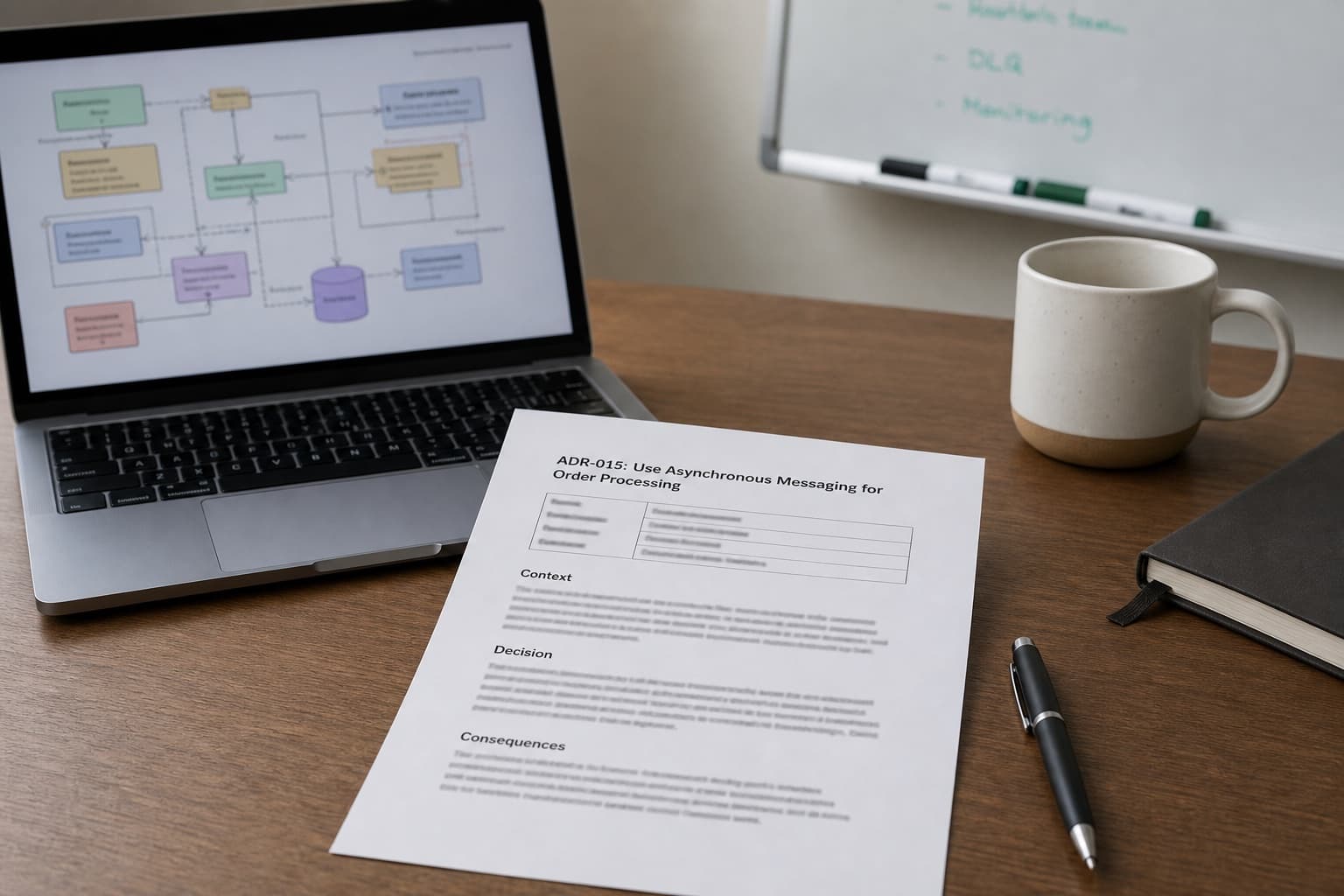
Standard ADR format (Nygard-style)
Most teams use a short markdown file per decision:
| Section | Purpose |
|---|---|
| Title | Decision in plain language ("Use PostgreSQL for billing ledger") |
| Status | proposed → accepted → deprecated/superseded |
| Context | Forces at play: incident, scale, compliance, team skill |
| Decision | What we chose—in one or two sentences |
| Consequences | Positive, negative, and follow-up work |
Optional fields many repos add: Date, Deciders, Supersedes, Links to design docs or tickets.
ADRs are immutable history. When a decision changes, write a new ADR that supersedes the old one—do not silently edit accepted text.
What engineering teams punish in ADRs
| Element | Weak AI ADR | Strong team ADR |
|---|---|---|
| Context | Generic "need scalability" | Specific incident, metric, or deadline |
| Options | One fake alternative | Real paths debated in meeting |
| Rejected option | Missing | Named with why it lost |
| Consequences | Vendor ad copy | Ops cost, migration work, risks you accept |
| Links | Broken or generic | Ticket, design doc, RFC number |
Design docs explore a system; ADRs freeze a fork. See humanize a design doc for broader proposals—link from the ADR, do not merge them.
Context / decision / consequences before any model
Before ChatGPT or Human Writes, write from meeting notes:
- Trigger — what forced the decision now (SEV, quota, launch date)
- Constraints — non-negotiables (HIPAA, existing Kafka, two-person team)
- Options considered — at least two real approaches with one-line pros/cons
- Rejected option — the path you said no to, with the reason that still holds
- Decision — the choice, named precisely (product, pattern, boundary)
- Consequences — good, bad, and "we need to build/monitor X by date"
If you cannot name (3) from someone in the room, schedule fifteen minutes before you file the ADR.
Do not paste production secrets into consumer chatbots. Redact connection strings; work from internal templates.
Typical ADR template
# ADR-0042: Store invoice events in PostgreSQL, not Redis streams

## Status
Accepted

## Context
Billing replay failed twice in Q2 (INC-891, INC-904). Redis stream trimming
lost events under memory pressure. Finance requires 7-year audit trail.

## Decision
Persist invoice events to PostgreSQL with append-only table `invoice_events`.

## Consequences
+ Durable audit trail; familiar ops runbooks
- Higher write latency vs Redis; migration job for historical events (JIRA-4412)
- Deprecate stream consumer ADR-0031 after backfill completes
| Section | Humanize? | Why |
|---|---|---|
| Status / dates / ADR number | No | Repo integrity |
| Service / table names | No | Implementation truth |
| Context narrative | After facts locked | AI loves vague scale |
| Consequences bullets | After facts locked | Must reflect real tradeoffs |
Paste context and consequence prose into Human Writes once. Restore every ticket ID, service name, and date exactly.
Before and after (context section)
AI context:
The team requires a scalable, robust solution for data storage. Modern applications benefit from flexible architectures. Several stakeholders expressed interest in improving system reliability.
After meeting notes locked:
After INC-904, replay dropped 3.2% of invoice events when Redis hit
maxmemoryand trimmed streams (Grafana billing-replay panel, 2026-07-12). Finance audit (SOX) requires seven-year retention; Redis TTL policy conflicts. We must decide storage before Q3 close traffic (launch ticket FIN-220).
Second version gives the next reader why now and what breaks if they revisit the choice.
Workflow
- Copy your org’s ADR template into
docs/adr/(or equivalent). - Hold a short decision meeting—or extract from postmortem if the decision is obvious.
- Draft context, options, decision, consequences from notes—not from "write an ADR for microservices."
- Name one rejected option explicitly.
- Link superseded ADRs and related design doc.
- One Human Writes pass on wordy context paragraphs only.
- PR review from someone who was not the sole author—catch invented options.
- When the decision changes, new ADR with
Supersedes: ADR-0042.
Operational fallout belongs in runbooks; narrative of outages in postmortems. ADR points to both; it does not replace them.
What not to do
- Edit an accepted ADR in place when the decision reverses.
- Invent options the team never discussed.
- Humanize ticket IDs or schema names through paraphrase.
- Duplicate a full design doc inside the ADR file.
- List consequences copied from a vendor homepage.
Detector scores on internal repos are irrelevant. Wrong decision history wastes the next on-call. See ethical AI checklist for team policy on assistants in engineering docs.
Bottom line
ADRs win on context tied to a real trigger, a named decision, honest consequences, and a rejected option preserved. Human Writes is the clarity pass after your meeting notes are true—not best-practice filler future you cannot trust.
Paste stiff context paragraphs on Human Writes when every consequence bullet maps to work someone already ticketed.