
How to Humanize an Argumentative Essay After ChatGPT
ChatGPT argumentative essays stack claims without warrants and cite readings you never opened. Lock thesis, evidence from assigned texts, and warrant sentences first. Humanize body prose once—not invented quotes.
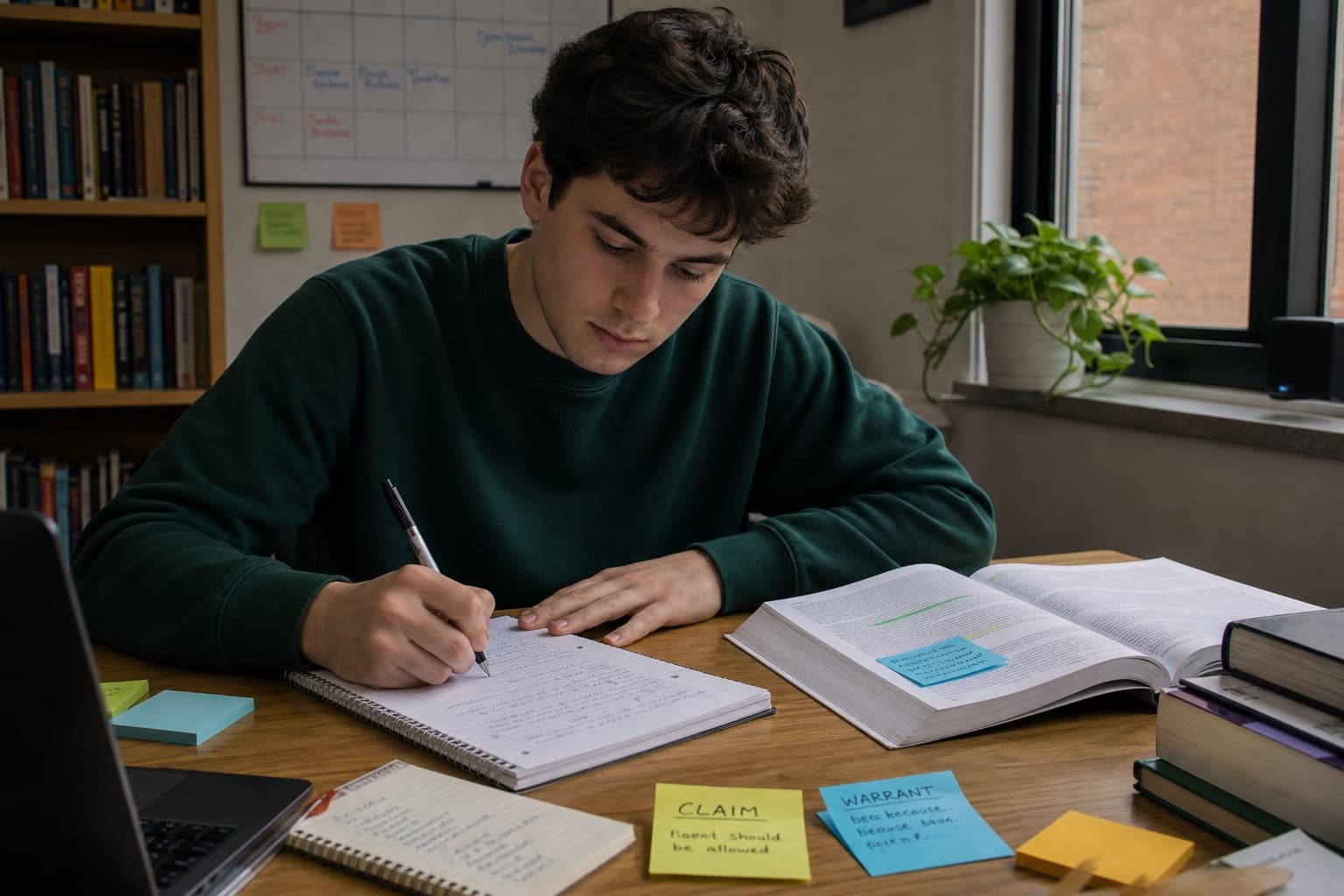
Argumentative essays are graded on claim, evidence, and warrant—not on how many transition words fit on a page. ChatGPT stacks confident claims, drops block quotes that sound right, and skips the warrant: the sentence that explains why the evidence proves the claim.
Professors who assigned Foucault last Tuesday notice when your paper cites a page that does not exist. Humanizing without fixing the argument produces polished nonsense.
Related: how to humanize a ChatGPT essay, literature review synthesis, ethical AI checklist.
What argumentative rubrics punish
| Element | Weak AI draft | Strong reading-based draft |
|---|---|---|
| Claim | "Technology is harmful to society" | Takes a side on this prompt with a scope you can defend |
| Evidence | Vague "studies show" | Quote or paraphrase from an assigned text, with page |
| Warrant | Missing or "this proves my point" | Names the logic: cause, definition, comparison, authority |
| Counterargument | Straw man nobody holds | Engages a real position from class discussion |
| Voice | Five-paragraph template | Sounds like you argued in seminar |
Claim + warrant before any model
Before ChatGPT, write three lines by hand:
- Thesis (claim): One sentence that answers the prompt with a limit ("in chapters 3–5," "for the narrator only").
- Best evidence: One quote or paraphrase you highlighted—with author, title, page.
- Warrant: "This matters because…" (connects the quote to the thesis).
If you cannot write (3), you do not have an argument yet. Re-read the passage.
Do not paste entire PDFs into a consumer chatbot if your campus policy forbids it. Work from notes and legal excerpts you are allowed to use.
Typical essay structure
Adjust to your rubric, but most argumentative assignments look like:
- Introduction — context, thesis, roadmap
- Body paragraphs — claim → evidence → warrant → link back
- Counterargument + rebuttal — fair summary, then your reply
- Conclusion — restate thesis without new evidence
| Section | Humanize? | Why |
|---|---|---|
| Block quotes | No | Accuracy |
| Page numbers / titles | No | Citation integrity |
| Warrant sentences | After evidence locked | AI often skips the "because" |
| Introduction / conclusion | Light, one pass | Often the stiffest blocks |
Paste analysis paragraphs into Human Writes once. Put back every quotation mark exactly as in the book.
Before and after (warrant)
AI body paragraph:
Furthermore, the author discusses important themes throughout the novel. This clearly demonstrates that society faces many challenges. Research shows that readers should reconsider their assumptions.
After claim + warrant from class reading:
Morrison ties Sethe's choice to schoolteacher's ledger (Beloved, 163): the body is priced before the person is named. That scene supports my claim that the novel treats ownership as violence that outlives legal emancipation—not as a metaphor for "general hardship."
Second version has a claim, evidence from the assigned text, and a warrant that names the logic.
Workflow
- Read the prompt twice. Underline "must use" sources.
- Build a one-page evidence table: claim chunk → quote → page → warrant in ten words.
- Draft body paragraphs from the table—not from "write an argumentative essay about X."
- Write intro and conclusion yourself (readers weight both heavily).
- Add one counterargument someone actually made in class.
- One Human Writes pass on stiff analysis prose.
- Walk every quote against your physical or PDF highlight.
- Disclose AI editing if the course requires it.
For shorter opinion posts in discussion boards, see discussion posts. Same claim–warrant discipline, fewer pages.
What not to do
- Cite articles not on the syllabus.
- Drop block quotes with no warrant sentence after them.
- Let the model invent page numbers or chapter titles.
- Humanize five times until your thesis drifts.
- Treat a humanizer as a way to submit a reading you skipped.
Scores on detectors are a review signal, not a grade. A missing warrant fails faster than a percentage. See best practices for humanizing.
Bottom line
Argumentative essays win on a defensible claim, evidence from assigned readings, and warrants you can explain aloud. Human Writes is the voice pass after your evidence table is true.
Paste stiff analysis paragraphs on Human Writes when every quote points to a page you can open in office hours.