
How to Humanize Children's Book Text (Age Band and Read-Aloud)
ChatGPT kids books sound like essays with short sentences. Lock age band, word count per spread, and read-aloud rhythm before AI. Humanize with Story purpose once–no new plot or vocabulary above band.
Children's book text fails when it reads like a summary with line breaks. ChatGPT writes about "the importance of friendship" in vocabulary a seven-year-old would not say aloud. Editors and parents ask: can I read this spread once, at bedtime, without tripping?
Human Writes is the narration pass after age band, spread map, and read-aloud test are locked. Story purpose. One pass. It does not invent a new character in the last spread.
Related: short story discipline, show don't tell, fiction hub, AI disclosure for contests and KDP.
What age bands punish
| Band | Typical length | Text rules | AI failure mode |
|---|---|---|---|
| Board book (0–3) | 0–100 words total | One idea per spread; concrete nouns | Abstract "feelings" |
| Picture book (3–7) | 300–800 words | Read-aloud rhythm; page turns | Moral speech at the end |
| Early reader (5–7) | 100–800 words | Controlled vocabulary; short lines | Essay sentences |
| Chapter book (7–9) | 1,500–10,000 words | One subplot max | Biography pacing |
Pick one row and stay there. A picture book draft with chapter-book vocabulary fails acquisition before art is assigned.
Lock the spread map before ChatGPT
Write a spread table by hand (picture book example):
| Spread | Visual beat | Text (max words) | Page turn hook |
|---|---|---|---|
| 1–2 | Kid finds boot in mud | ≤25 | Whose boot? |
| 3–4 | Boot talks (one joke) | ≤30 | Boot wants home |
| 5–6 | Rain; kid carries boot | ≤25 | Wrong house |
| 7–8 | Right porch; boot quiet | ≤20 | Last image only |
If Visual beat is empty, you are not ready to draft. Illustrators pace from your turns–not from ChatGPT's moral paragraph.
Prompt with the table and: "Write text only for each spread. Age 4–6 read-aloud. Max words per row. No new characters after spread 4. No 'learned that' ending."
Read-aloud test (non-negotiable)
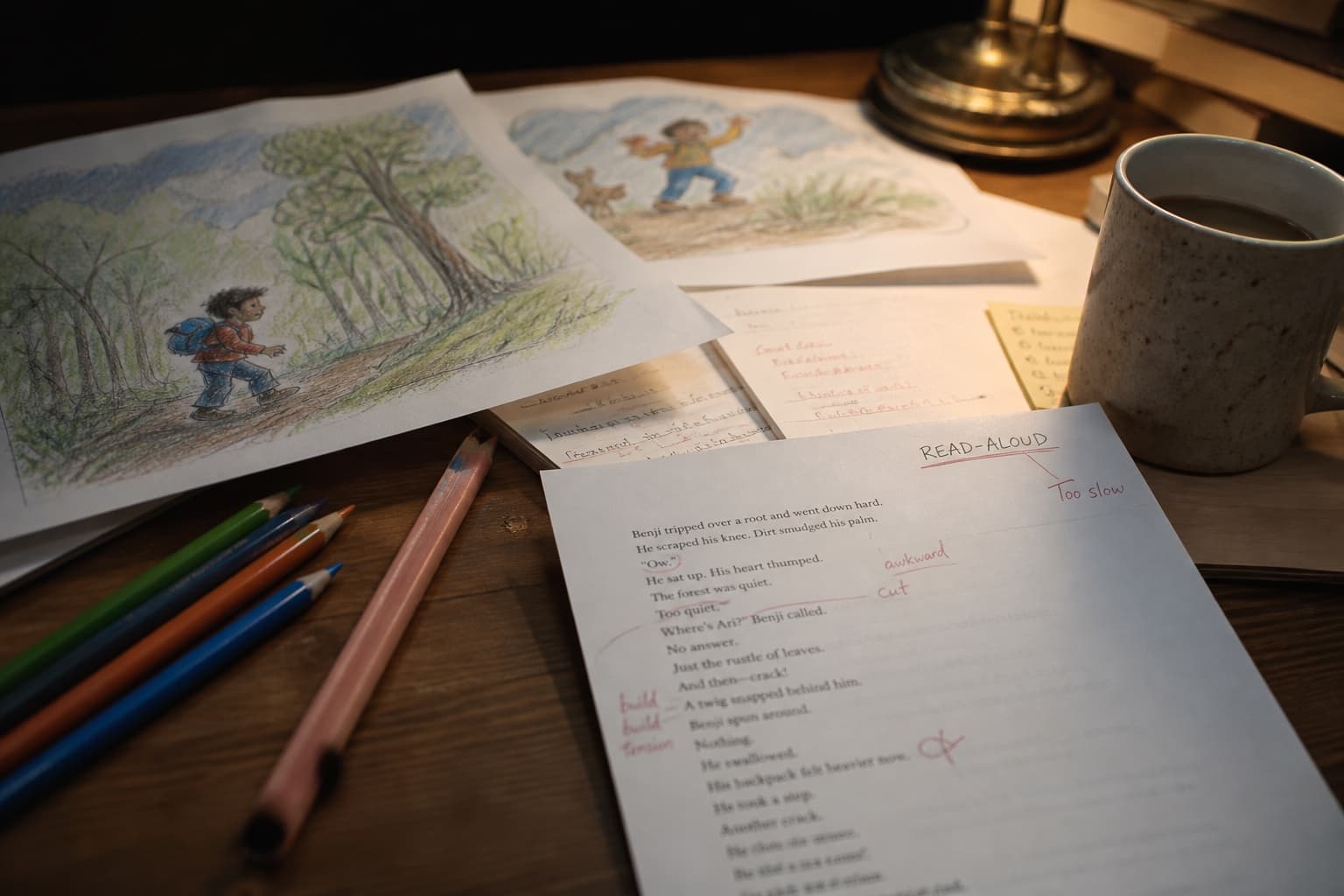
Before Human Writes, read every spread out loud once:
| Pass | Listen for | Fix before humanize |
|---|---|---|
| Tongue twisters | Stumble on consonants | Swap nouns |
| Run-on spread | Breath before page turn | Cut or split |
| Lesson line | "And so they learned…" | Delete; show in image note |
| Wrong register | Words kid would not say | Replace with concrete verb |
| Even rhythm | Every sentence same length | Vary after lock |
Parents and teachers are the detector. Uniform sentences fail faster in 400 words than in a novel.
Where Human Writes helps
| Pass | Use Story purpose? |
|---|---|
| Spread map / age band | No |
| Illustrator notes | No |
| Dialogue (if any) | Separate, light pass |
| Narration per spread | Yes, once |
| Title and back matter | You write; no model moral |
Paste one spread at a time on Human Writes with Story purpose. If output adds a new object or feeling word above band, revert.
Before and after (picture book spread)
AI draft (spread 5–6):
Maya realized that helping others was the most important thing of all, and she felt happy knowing she had been a good friend throughout the adventure.
After spread map + Story purpose pass:
The boot dripped on the step. Wrong porch. Maya turned back into the rain.
Same band. Second version turns the page without a sermon.
Workflow
- Choose age band; look up 3 comp titles you read this month (word count, tone).
- Fill spread table or chapter outline with visual beats.
- Draft text from the table–not "write a children's book about kindness."
- Read aloud; mark stumbles in pencil.
- Send illustrator notes separately; do not humanize art direction into the manuscript.
- One Story purpose pass per spread or scene.
- Word-count check against band; disclose AI if publisher or contest requires.
For longer kid voice in early chapter books, rhythm overlaps short story narration. For query metadata after the ms is done, query letters.
Vocabulary and sentence length by band
Use a word ceiling per band before Human Writes:
| Band | Max sentence words | Vocabulary note |
|---|---|---|
| Board book | 5–8 | One concrete noun per line |
| Picture book | 8–12 | Dialogue tags: "said" is fine |
| Early reader | 6–10 | Repeat key words for confidence |
| Chapter book | 12–15 | One new word per chapter max |
Run manuscript through a grade-level checker after your pass–not before. If the tool flags a word you chose on purpose (a repeated refrain), keep it. If ChatGPT inserted " magnificent" in a board book, cut it.
Disclosure and submission
Magazines, agents, and KDP programs increasingly ask how AI was used. Log it like fiction writers do elsewhere: date, tool, which spreads got a Story purpose pass, and what stayed yours (outline, last line, illustrator notes). See AI disclosure for contests and KDP. Humanizing narration is not disclosure and not a substitute for reading the submission rules.
What not to do
- Mix board-book brevity with chapter-book plot in one file.
- Humanize until the boot gains a backstory you did not plan.
- Add "squeaked" and "exclaimed" on every dialogue tag.
- Paste the whole manuscript into one Human Writes pass–spreads blur.
- Submit without reading aloud to a child or a tired adult at kitchen-table speed.
Bottom line
Children's books win on age band, page turns, and read-aloud rhythm–not on stated morals. Human Writes is the Story purpose pass after your spread map is true.
Paste one locked spread on Human Writes when you can read it aloud without stopping to breathe mid-sentence.