
How to Humanize a Student Legal Memo After ChatGPT
ChatGPT legal memos invent cases and blur the Question Presented. Lock IRAC from authorities you actually read. Humanize analysis voice once, never hallucinated citations.
A student legal memo is an IRAC (or CREAC) audit trail, not a persuasive op-ed. ChatGPT memos sound courtly and often invent cases, mash holdings, or answer a Question Presented you never asked. Polishing that prose produces polished malpractice for class.
Human Writes is the voice pass after your authorities and outline are locked. It is not Westlaw. It will not Shepardize. It will not invent Smith v. Jones.
Related: policy memo for class, case study assignment, argumentative essay, ethical AI checklist.
What LRW graders punish
| Element | Weak AI memo | Strong student memo |
|---|---|---|
| Question Presented | Vague policy musing | Precise legal question under the facts |
| Short answer | Hedged essay | Yes/no/likely with one-line why |
| Rule | Generic “courts consider…” | Elements from cases you briefed |
| Application | Fact-free adjectives | Fact-to-element matching |
| Authority | Hallucinated cites | Packet / Westlaw / casebook only |
| Tone | Advocacy speech | Predictive office-memo voice |
Detectors may flag smooth Discussion. Professors flag fake cases and missing elements first.
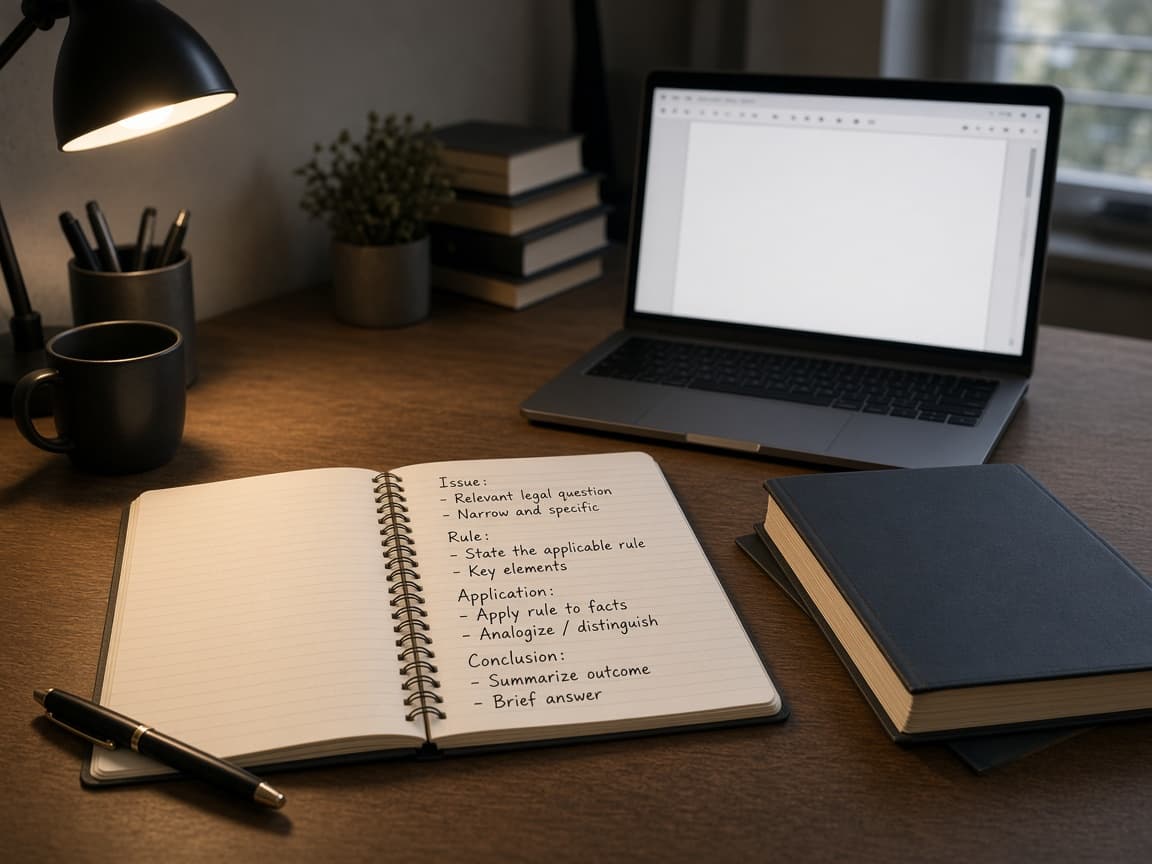
Lock IRAC before any model
Before ChatGPT or Human Writes, fill this card from authorities you opened:
| Field | Your entry |
|---|---|
| Question Presented | One sentence; jurisdiction if required |
| Legally significant facts | Only facts the hypo gives |
| Cases / statutes in play | Full cite + page/pincite you read |
| Rule / elements | List elements; note splits if any |
| Application outline | Each element → facts that cut for/against |
| Counterargument | Strongest opposing reading |
| Short answer | Predictive, not theatrical |
Prompt: “Turn this IRAC card into a memo outline. Do not add cases. Keep my Question Presented wording. Flag any element with no facts as [GAP].”
If a case is not on your card, it does not enter the memo. Models complete the shape of legal writing. They do not own your reporter.
IRAC section checklist
| Section | Keep sacred | Soften with humanize |
|---|---|---|
| Caption / QP / Short Answer | Exact issue framing | Clarity only |
| Statement of Facts | Hypo fidelity | Cut AI flourish |
| Rule / Rule Explanation | Quotes and elements | Cadence around cites |
| Application | Your mappings | Voice, once |
| Counterargument / Reply | Fair strength | Tone |
| Conclusion | Matches short answer | No new authority |
Citation format (Bluebook or local) stays exact. Do not “humanize” a pincite into a paraphrase of a holding you did not check.
Before and after (Application paragraph)
AI sludge:
Courts have long recognized that fairness and justice require a holistic, nuanced balancing of the equities in cases such as this, as seen in numerous precedents supporting the plaintiff’s position.
After IRAC card + verified cases:
Under Patel’s two-element test (handout pp. 14–15), the first element is met: the hypo states the guard locked the gate before 9 p.m. The second element is weaker: nothing in the facts shows notice to the night crew, which Patel treated as required (p. 16).
Second version is gradable. It can be wrong on the reading. That is still better than imaginary precedent.
Workflow
- Brief every assigned case; mark holdings and key facts with page numbers.
- Fill the IRAC card by hand from the hypo.
- Draft from the card only. Ban “find cases about X” in a consumer chatbot for graded work unless your professor allows research AI under rules you follow.
- Verify every citation against the PDF or reporter before any polish.
- One Human Writes pass on stiff Application or Discussion prose.
- Re-check quotes and pincites character-for-character.
- Disclose AI editing if your honor code or syllabus requires it (ethics checklist).
For longer academic synthesis without fake sources, see literature review and citations habits. For predictive vs persuasive tone in non-law courses, policy memo is the cousin assignment.
Predictive voice vs advocacy
Office memos predict how a court or decision-maker would likely rule on these facts. They are not closing arguments. AI drifts toward uplift (“justice requires”) and away from element matching. When you humanize Application, keep the predictive frame: likely / unlikely / unclear on this record - with facts attached.
If your assignment is a motion or brief instead of a memo, persuasion rules change, but authority discipline does not. Still ban hallucinated cases. Still verify every pin cite.
| Genre | Goal | AI trap |
|---|---|---|
| Predictive memo | Advise on likely outcome | Invented neat rule |
| Persuasive brief | Argue for a side | Fake supporting authority |
| Case brief (class) | Accurate holding | Merged cases into one |
What not to do
- Accept a case name the model “remembers.”
- Let the humanizer rewrite quoted rule language.
- Turn a predictive memo into a closing argument.
- Chase a detector score instead of element coverage.
- Paste confidential clinic client facts into a public chatbot if your school forbids it. Work from redacted hypos you are allowed to share.
- Cite a case from memory without opening the page.
Bottom line
Student legal memos win on IRAC discipline and authorities you actually read. Human Writes polishes analysis voice after the citation table is true - never as a cure for hallucinated cases.
Related: take-home exam, book review assignment, best practices for humanizing.