
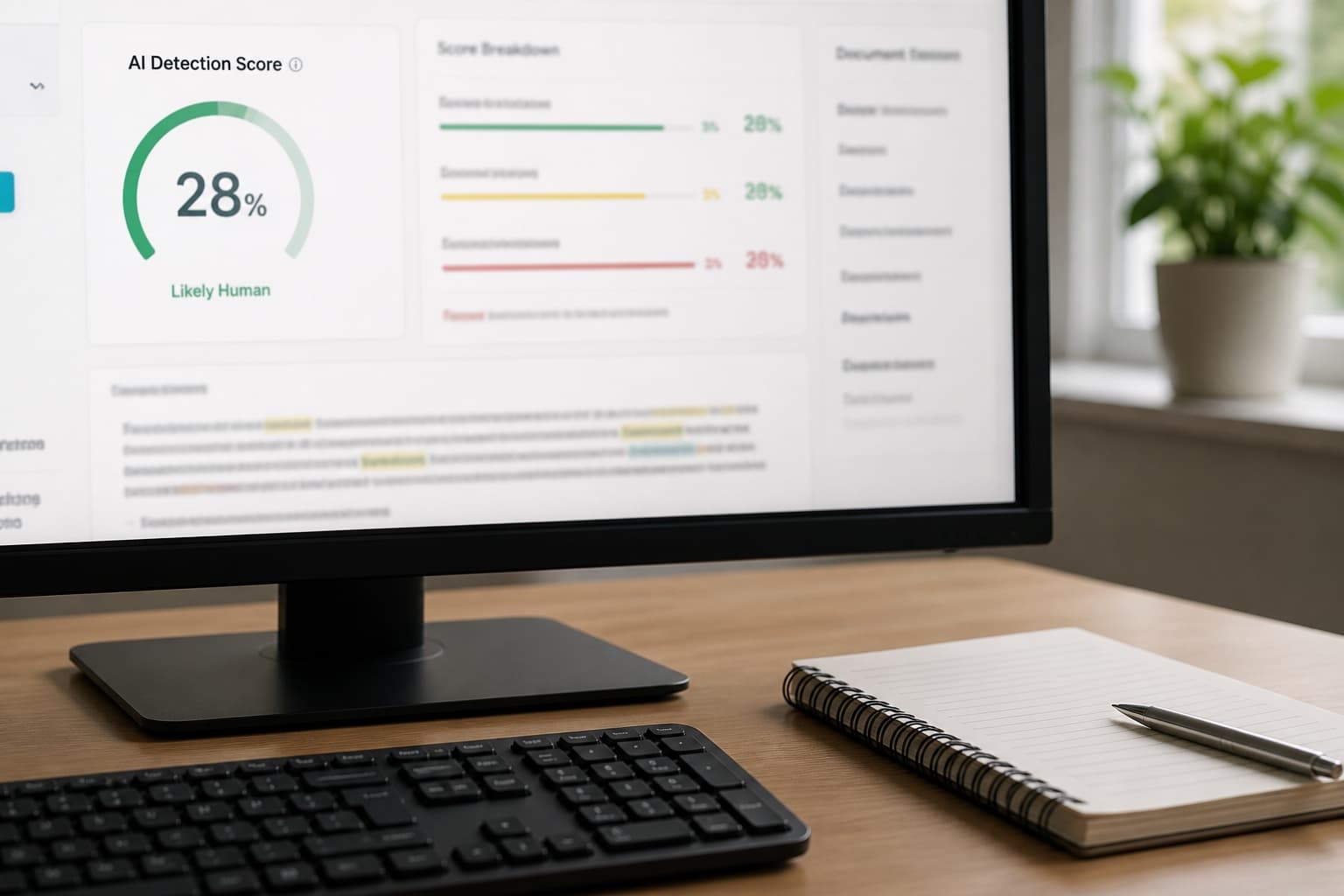
Pangram AI Detector Guide: How to Read the Score (2026)
Pangram returns segment labels, AI assistance scores, and humanizer flags—not a single magic percentage. Who uses it, how to read Pangram 4 output, and Human Writes bias disclosed.
Pangram shows up next to GPTZero in searches about AI detection—especially after Pangram 4 shipped with segment labels, mixed-authorship fractions, and a humanizer flag. The product is a detector. It is not a court.
This guide covers who uses Pangram, how to read Pangram 4 output, and what to do instead of treating one number as fate. Broader landscape: GPTZero vs Other AI Detectors. Why tools disagree: How Accurate Are AI Detectors in 2026?.
Human Writes bias, stated up front: we sell a humanizer with a built-in score. That score is also a signal, not a passport. We have no partnership with Pangram. Use their report and ours as review tools—not as guarantees.
Who actually uses Pangram
| Audience | Why they open it |
|---|---|
| Teachers / writing centers | Second check when prose feels unlike prior work |
| Publishers / magazines | Screen submissions and syndicated copy |
| ESL / language programs | Multilingual checks; vendors claim lower ESL false-positive rates |
| SEO and agency QA | Client “no AI” clauses |
| Students | Self-check before a school tool (often Turnitin) |
If your syllabus names Turnitin or GPTZero, that is usually the report that matters for the course. Pangram is useful as a second opinion, not a substitute for the assigned pipeline.
Pangram 4: what the output includes
Pangram 4 (2026) is more than a headline percentage. Typical successful responses include:
| Field | What it is |
|---|---|
| label | Human Written, AI-Assisted, or AI-Generated per segment |
| ai_assistance_score | 0–1 involvement estimate per window—not “62% confident” |
| fraction_human / fraction_ai_assisted / fraction_ai | Character-weighted document mix |
| humanizer_score | Likelihood a humanizer touched the segment |
| is_humanized | Flag when humanizer_score crosses an internal threshold (default ~0.91 at release) |
| confidence | High / Medium / Low on the segment label |
The ai_assistance_score is computed as AI-Generated probability plus half of AI-Assisted probability. A segment at 0.62 does not mean “62% AI.” It means the blended involvement estimate landed there; the label came from a separate decoding path.
Read spans, not vibes.
How to read the percentage (practical)
| You see | You should do |
|---|---|
| High AI on a raw ChatGPT paste | Expected. Add your facts; do not submit this |
| High AI on work you wrote | Check length, ESL formality, templates; see false positives |
| Mixed / mid document | Fix highlighted segments; not wholesale rewrite |
| is_humanized true after one edit pass | Normal if you used a rewriter; still check authorship and facts |
| Low AI on a draft you cannot explain | Process problem, not software victory |
Do not average Pangram, GPTZero, and Turnitin and call it science. See built-in score vs third-party detectors.
Pangram vs GPTZero vs Turnitin (practical)
| Job | Better default |
|---|---|
| School of record | Whatever the LMS assigned (often Turnitin) |
| Quick self-check | Pangram or GPTZero—then read spans |
| Segment + humanizer flag | Pangram 4’s differentiator |
| Client SEO SLA | Whatever the contract named; document the mode |
Vendor marketing cites high accuracy on benchmark splits. Third-party tests still vary by genre, length, and editing. Treat published false-positive rates as marketing inputs, not your personal odds. Details: AI detection accuracy overview.
What highlighted spans usually mean
If Pangram paints a paragraph, read it aloud. Typical hits:
- Even sentence length with no aside
- “It is important to note” stacks
- Methods or policy blocks from a template
- Conclusions that never name your result
Fix those spans with your facts and rhythm—not with five rewriter loops. Perplexity and burstiness explain why detectors flag statistical regularity; they do not justify bypass shopping.
If you used Human Writes before Pangram
Workflow that matches how we product:
- Lock facts (numbers, quotes, biography) by hand.
- One Human Writes pass on stiff prose.
- Re-read for accuracy—not for a target score.
- Optional: Pangram self-check; edit flagged spans.
- Disclose AI assistance if school or client requires it.
We do not promise a Pangram score. Humanizer detection is explicitly part of Pangram 4’s design. Chasing “undetectable” is the wrong goal. See ethical AI checklist.
Comparison of rewrite approaches (bias disclosed): Best AI Humanizers Compared.
What not to do
- Treat is_humanized as automatic misconduct.
- Paste the same essay through five tools and pick the lowest number.
- Use Pangram to accuse someone without a conversation about drafts and sources.
- Assume multilingual mode fixes every ESL false-positive case—still read the spans.
Teachers: software-only accusations are weak process. See how teachers spot AI homework.
Bottom line
Pangram 4 is a segment-level review tool with AI involvement scores and humanizer flags—not a single verdict. Read labels, fractions, and highlighted windows. Fix authorship and facts first.
If you humanize with Human Writes, treat Pangram like any other detector: a signal to edit, not a guarantee to chase.