
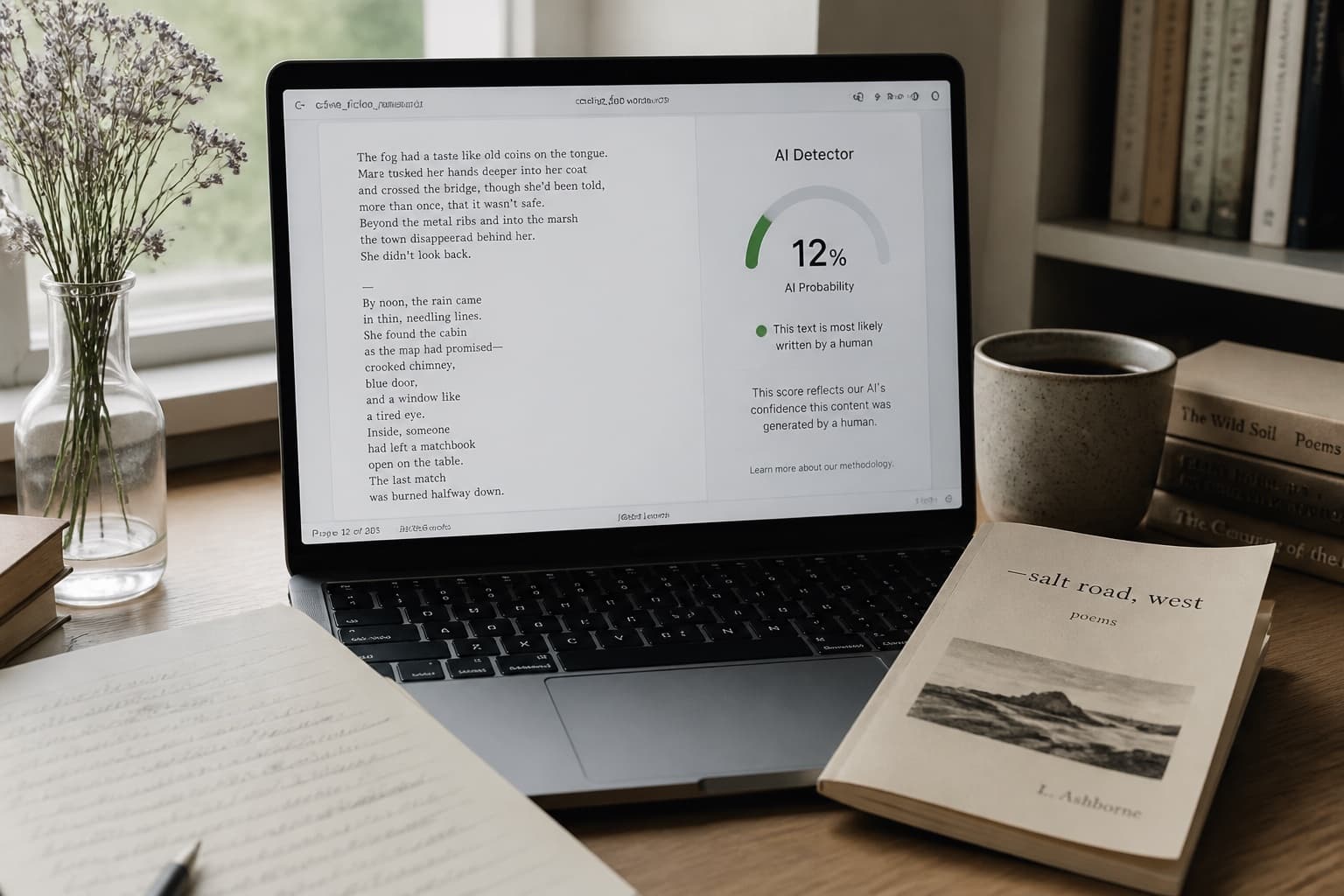
AI Detectors and Creative Writing False Positives
Detectors trained on essays flag polished fiction and sparse poetry. Understand why short, stylized, and edited creative work triggers scores—and how to document authorship without trusting a percentage.
A novelist gets a 92% AI score on a chapter drafted in 2019. A poet's twelve-line workshop piece flags after she removes one abstract noun. A screenwriter's present-tense action block reads "machine" to a browser extension trained on blog posts.
None of them used ChatGPT for those pages. All of them hit creative writing false positives—a blind spot detectors share because they were built for essays, homework, and SEO articles, not for voice, line breaks, and deliberate stylization.
This post explains why fiction and poetry get misread, what patterns trigger scores, and how to protect your work without treating humanizing as a detector game. For human-authored prose wrongly flagged in school or work contexts, start with AI detection false positives and detector accuracy in 2026.
Why creative writing is a hard case for detectors
| Detector assumption | Creative writing reality |
|---|---|
| Long, explanatory paragraphs | Sparse dialogue and white space |
| Informative tone | Character voice, unreliable narrators |
| Standard essay transitions | Fragments, dialect, poetic compression |
| One author "school" voice | Multiple characters + narrator |
| More text = more signal | Flash fiction and poems are tiny samples |
Short samples increase variance. A sonnet gives a classifier almost nothing stable to measure—so noise looks like guilt.
Genres that false-positive more often
| Genre / form | Trigger pattern | Why tools misfire |
|---|---|---|
| Literary fiction | Even cadence after line edit | Reads "smooth" like AI polish |
| Poetry | Regular line length, abstract nouns | Matches AI poem templates |
| Screenplay action | Present tense, short blocks | Overlaps AI action-line defaults |
| Children's books | Simple syntax by design | Looks like generic AI "simple" mode |
| Translated fiction | Uniform formal English | Similar to non-native formal training data |
| Romance / genre beats | Predictable scene shapes | Models confuse trope with machine |
Craft posts in our fiction cluster address voice, not scores: ChatGPT fiction hub, dialogue, poetry, short stories, screenplay action, romance voice, children's book text, novel chapters, and KDP/contest disclosure rules.
Fiction: before and after editing (detector sees editing, not authorship)
Human draft (rough, distinct voice):
Mira didn't trust the bridge. She said it out loud, which was unlike her, and Jae laughed the kind of laugh that means they were thinking the same thing but didn't want to say it yet.
After heavy copyedit toward "clean" workshop prose:
Mira expressed her concerns regarding the structural integrity of the bridge. Jae responded with a laugh that suggested shared apprehension without explicit acknowledgment.
The second version is more likely to flag—not because it is AI, but because it lost idiosyncrasy and gained essay voice. Detectors often reward mess less and punish polish more.
Poetry: false positive mechanics
| Poem feature | Detector misread |
|---|---|
| Even line lengths | "Metronome AI" |
| Abstract nouns (shadow, threshold) | Stock AI imagery bank |
| Explained last line | AI epiphany template |
| Workshopped uniformity | Single-voice completion |
Human poets do these things on purpose. Tools cannot distinguish intentional craft from template completion in twelve lines.
For fixing your line breaks and diction after AI assist—not chasing scores—see humanize poetry after ChatGPT.
What not to trust
| Myth | Reality |
|---|---|
| "0% means human" | Vendors report false negatives too |
| "Humanize until green" | Scores shift arbitrarily; craft beats percentages |
| "Detectors understand story" | They score token patterns, not meaning |
| "One tool is enough for contests" | Tools disagree on the same page |
| "Publication = safety" | Editors use the same flawed tools |
Human Writes rewrites rhythm for work you already own. It is not a guarantee against any vendor score, and it is not a substitute for contest or publisher disclosure rules.
Protect yourself (process, not paranoia)
- Keep layers of evidence: dated drafts, outline notes, beta reader emails, version history.
- Document AI use honestly when a market asks—humanizing does not erase assist; see KDP and contests.
- If flagged, ask which tool and which passage—appeals need specifics (Turnitin false positive appeal for classroom overlap).
- Revise for voice, not for a dashboard: uneven sentence length, character-specific diction, and concrete images help readers and may reduce false flags as a side effect.
- Compare tools on the same excerpt before you panic—disagreement is common (Copyleaks vs Originality).
When humanizing helps creative work (the right reason)
Use Story purpose on locked scenes when you used AI for draft assist and the page sounds like nobody:
- Dialogue flat while action reads fine → fix in dialogue post, not a whole-manuscript paste.
- Chapter narration evenly robotic → novel chapters workflow.
- Poem diction abstract after draft → poetry post.
Do not run five loops to chase a green badge. Do not publish AI assist without checking that market's rules.
Bottom line
Creative writing false positives happen because detectors were not built for fiction and poetry. Polished, sparse, or heavily edited work can score like a chatbot even when every line is yours.
Protect your process, disclose when required, and humanize for voice—not for a percentage. Start craft fixes in the fiction hub; start appeals evidence in false positives.
Paste stiff creative prose on Human Writes with Story purpose after the scene, breaks, and beats are locked—not to game a detector score.