
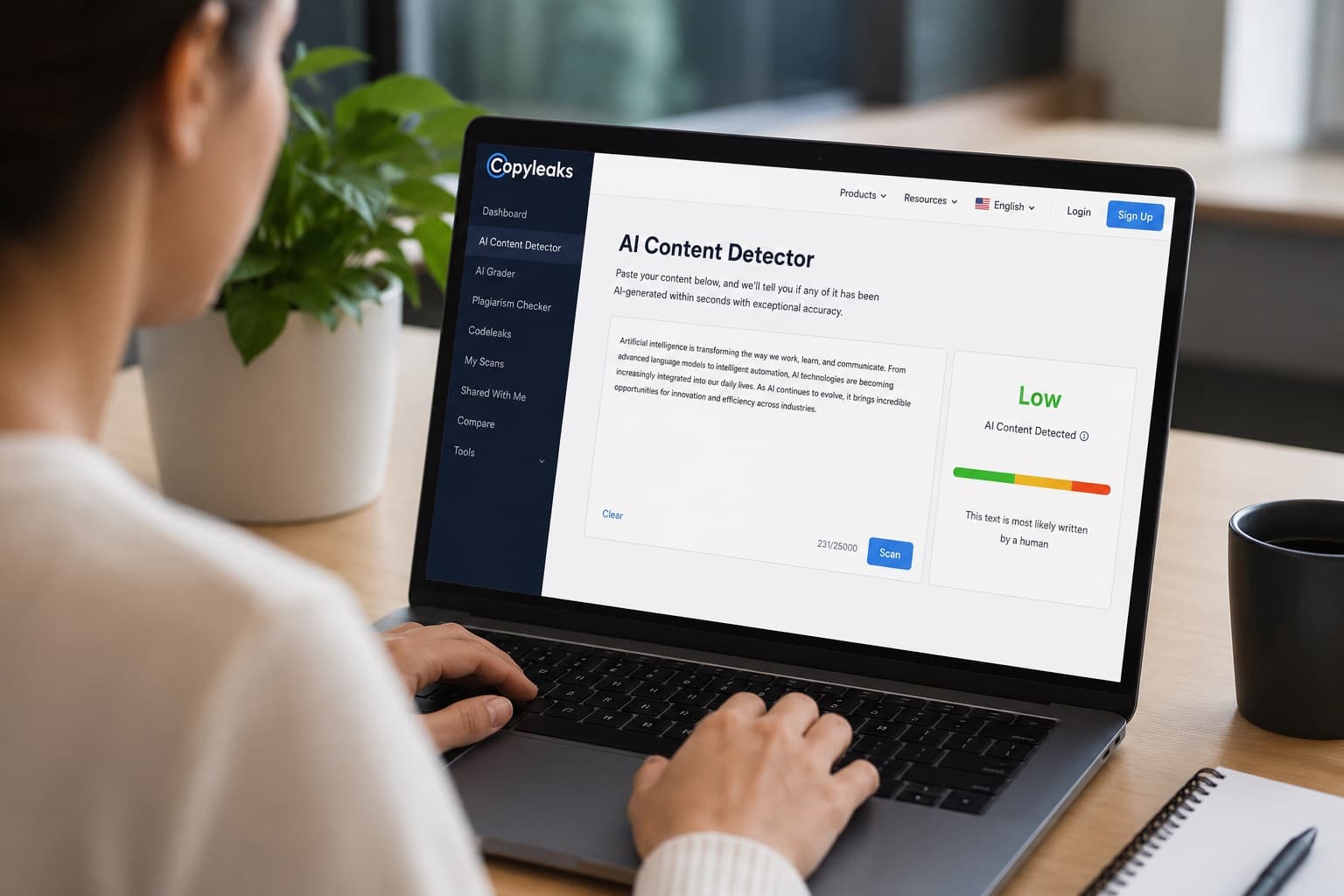
Copyleaks AI Detector: How It Works and How to Pass It
Copyleaks is one of the strictest AI detectors in independent testing. How it analyzes text, where it fails, and how to prepare content that holds up.
Copyleaks started as a plagiarism platform for schools and publishers. AI detection came later, and for many enterprise buyers, it became the main reason to renew.
If your employer, LMS, or client workflow mentions Copyleaks, you are facing one of the sharper detectors in common use. Not flawless. Not magic. But stricter than most free browser tools.
This guide explains how Copyleaks AI detection works, how it compares to alternatives, and what actually moves the needle when you need your writing to pass.
What Copyleaks checks
Copyleaks runs two related pipelines:
Plagiarism detection compares your text against web pages, academic databases, and prior submissions (depending on license).
AI content detection estimates whether prose was produced or heavily shaped by generative AI. Separate score, separate model.
Upload a file or paste text. You get percentage estimates, highlighted spans, and (on paid plans) API access for bulk or LMS integration. Universities and content agencies use the API to scan at scale.
Unlike a simple "ChatGPT detector" from 2023, Copyleaks markets multi-model coverage (GPT-family, Claude, Gemini, and others) with ongoing retraining. Exact model lists change; assume they lag newest model releases by months, like every vendor.
How the AI model judges your writing
Copyleaks does not publish full algorithm details. Public docs and vendor briefings point to the same family of signals other enterprise detectors use:
Token predictability. LLM text tends toward statistically likely word sequences. Human writing, especially drafts with typos, tangents, and odd word choices, scores less predictable.
Structural uniformity. Similar sentence length, repetitive transitions, and flat paragraph rhythm increase AI probability.
Semantic smoothness. Models over-explain and hedge. Phrases like "It is worth noting" and "In summary" cluster in AI output (and in bad human imitations of AI).
Cross-model fingerprints. Training on known AI outputs helps classifiers recognize remixes, including paraphrased or lightly edited AI.
Copyleaks also emphasizes modified AI detection: text that passed through paraphrasers or humanizers. No detector catches everything; marketing claims of 99% should be read skeptically. Still, Copyleaks sits in the "assume it is serious" tier.
For side-by-side accuracy notes (with caveats), see GPTZero vs Other AI Detectors.
Copyleaks vs. Turnitin, GPTZero, Originality.ai
| Tool | Typical buyer | AI + plagiarism | API / LMS | Free tier |
|---|---|---|---|---|
| Copyleaks | Enterprise, publishers | Both | Strong | ~1,200 words/mo |
| Turnitin | Universities | Both (institutional) | LMS-native | None for individuals |
| GPTZero | Education, individuals | AI-focused | Limited | ~10K chars/mo |
| Originality.ai | SEO agencies | Both | Yes | Small one-time trial |
Students: you may never see Copyleaks directly. Your school might route Turnitin or another LMS plugin that licenses Copyleaks or a rival backend. Ask IT which engine runs; do not assume GPTZero is what the professor uses.
Content teams: Copyleaks is common in agency SLAs ("all freelance copy scanned before publish"). Originality.ai is the usual SEO-shop alternative.
Accuracy snapshot (industry estimates, not lab guarantees):
| Tool | GPT-3.5-style text | GPT-4-style text | False positive risk |
|---|---|---|---|
| Copyleaks | High | Moderate–high | Moderate |
| GPTZero | High | Moderate | Moderate–high (ESL) |
| Turnitin AI | High | Moderate | Moderate |
| Originality.ai | Moderate–high | Moderate | Moderate–high |
Results swing by domain (legal writing vs. marketing blog vs. lab report). Always test your draft.
Where Copyleaks gets it wrong
False positives. Formal, non-native English writing sometimes triggers flags. Same problem across the industry. Documented cases appear in AI Detection False Positives.
False negatives. Deep humanization, heavy manual editing, or genuinely mixed human-AI collaboration lowers scores. Sophisticated evasion exists; so does sophisticated detection. Neither side wins forever.
Short text. Scores on a paragraph are noisier than on 800+ words. Do not trust a 120-word sample for a final verdict.
Heavily templated human text. Policy memos and legal boilerplate can look "machine-smooth" without ever touching an LLM.
Treat the score as a smoke alarm, not a courtroom verdict.
How to pass Copyleaks (without fooling yourself)
"Pass" here means: produce work that is yours, accurate, and not falsely flagged, not evade integrity rules.
1. Start from human structure
Outline arguments yourself. Use AI for brainstorming if policy allows, not for paste-ready sections.
2. Verify sources
Copyleaks will not fix hallucinated citations. Neither will any humanizer. See Best Practices for AI-Generated Citations.
3. Add non-fakeable detail
Course discussions, named datasets, specific page references, your own measured results. Detectors struggle when text carries idiosyncratic truth.
4. Humanize with detector-aware rewriting
Paraphrase tools alone often fail Copyleaks when the source was AI. Human Writes targets the rhythm and predictability signals Copyleaks-like models use, with a built-in score so you can iterate before the official upload.
Workflow comparison: Best AI Humanizers Compared (2026).
5. Edit flagged spans by hand
Automated pass → scan → fix highlighted sentences manually → rescan. Two cycles beat five blind full-document rewrites.
6. Run Copyleaks (or a proxy) before delivery
If you lack a Copyleaks seat, GPTZero plus Turnitin draft mode is imperfect but better than nothing. Align tools with what your client or school actually uses.
For essay-specific steps: How to Humanize a ChatGPT Essay.
Copyleaks pricing and access (2026)
Plans shift; approximate public tiers:
- Free: roughly 1,200 words per month, enough for a short essay section
- Paid personal/team: ~$10–25/month depending on page credits
- Enterprise: custom API, SSO, data retention controls
API calls consume credits per page or per request. Bulk scanning adds up for agencies; negotiate enterprise caps if you process thousands of files.
Privacy: logged-in scans typically store history. Enterprise contracts can restrict retention. Read the DPA if you handle student or client data.
Copyleaks in LMS and publishing pipelines
Common integration pattern:
- Student or writer submits draft
- LMS plugin sends text to Copyleaks API
- Similarity + AI reports return to instructor or editor
- Human reviewer decides next steps
Publishers use the same stack for preprint screening. If you freelance, assume your buyer runs something in this class even when they do not name the vendor.
Ethical use
Copyleaks exists to protect originality and trust. Using humanizers to submit AI work as unassisted violates many contracts and honor codes, even when the score is low.
When AI assistance is allowed:
- Disclose it
- Keep verifiable sources
- Make the analysis your own
Our ethical AI checklist maps common university expectations.
The bottom line
Copyleaks combines strong plagiarism coverage with AI detection tuned for institutional seriousness. It catches raw and lightly edited LLM text more often than casual free tools. It still misses careful human-AI collaboration and still flags innocent human prose sometimes.
Beating Copyleaks the right way means writing that is structurally yours, factually solid, and mechanically varied, then using humanization and testing as quality control, not as disguise.