
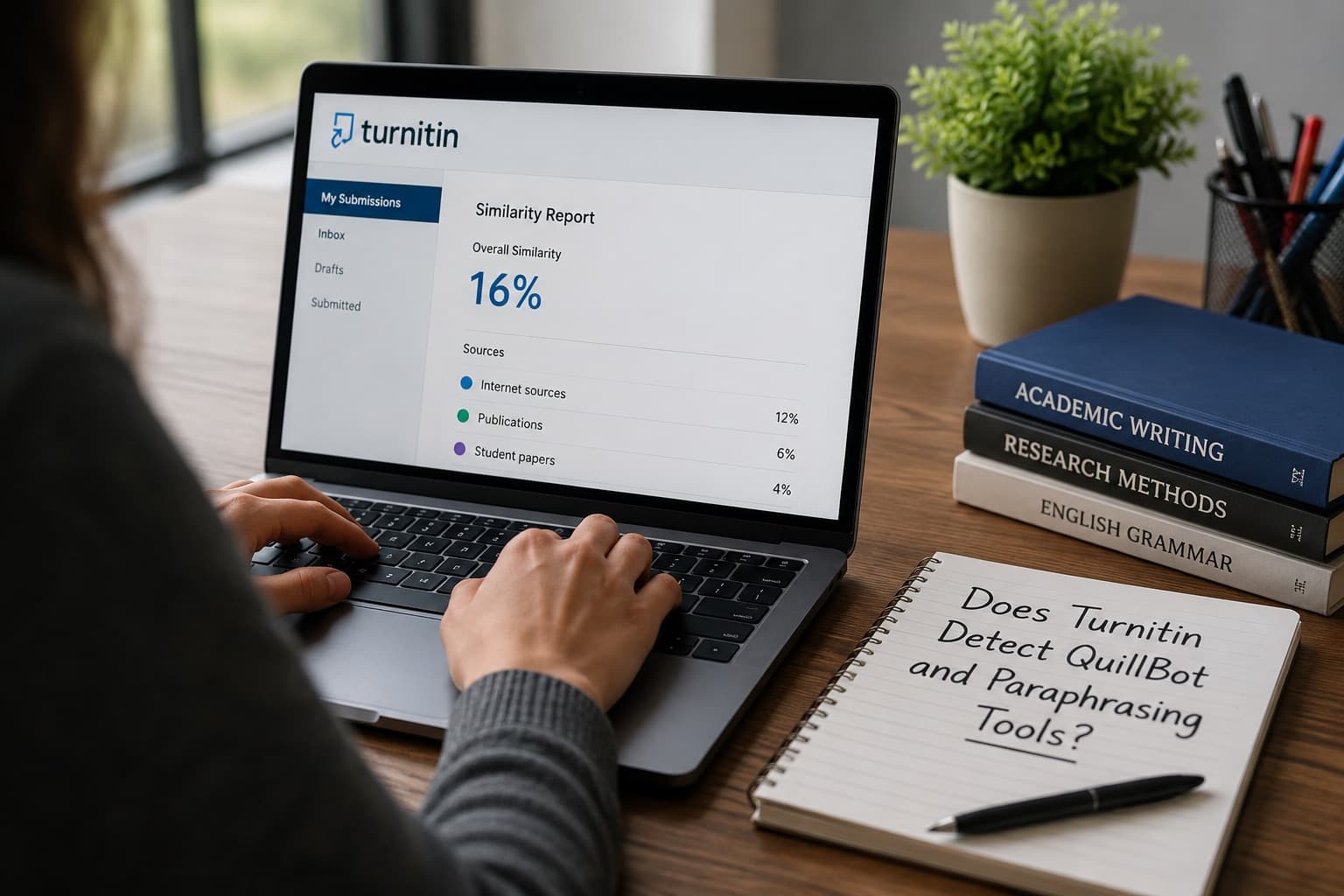
Does Turnitin Detect QuillBot and Paraphrasing Tools?
Turnitin flags AI text paraphrased by tools like QuillBot and now targets bypassers too. What it detects, what it misses and what counts as misconduct.
QuillBot is one of the most used writing tools among students. Its paraphraser rewrites sentences in different words, which makes it popular for avoiding plagiarism matches and, increasingly, for disguising AI-generated text. Turnitin knows this. Its AI writing report now separately highlights text it believes was generated by AI and then modified by a paraphrasing tool, and since 2025 it has included detection aimed at bypasser and humanizer tools. Paraphrasing does not make a problem disappear; it often moves it from one Turnitin report to another.
This guide explains what Turnitin detects, what it misses, and what counts as misconduct whatever the software says.
Two reports, two problems
Turnitin produces two separate reports. The similarity report compares your text with web pages, publications and past submissions. The AI writing report estimates how much of your prose was generated by AI. QuillBot affects them differently.
When you paraphrase a source with QuillBot, the words change, so the similarity score often falls. But the meaning still comes from the source, so if you do not cite it, it is still plagiarism. When you paraphrase AI-generated text with QuillBot, similarity was probably low already, and the AI report may now highlight the text as AI-generated and AI-paraphrased. Our guide to Turnitin similarity vs AI score explains the two reports.
What Turnitin says it detects
Turnitin's AI writing report has two highlighted categories: text likely generated by AI, and text likely generated by AI and then modified by an AI paraphrasing tool or word spinner. In 2025 it added detection aimed at AI bypassers, tools marketed specifically to make AI text undetectable. In 2026 it consolidated its models and updated them again. It does not claim perfect accuracy, and it says scores should prompt review rather than prove misconduct.
What it may miss
No detector catches everything. Text that a person has substantially rewritten, with their own structure, examples and reasoning, is much harder to detect than text run through a paraphraser. Short passages are not scored at all; Turnitin needs at least 300 words of prose. And detection varies over time as both tools update. None of this makes undisclosed AI use acceptable where your course prohibits it.
Paraphrasing tools and integrity rules
Many institutions now treat AI paraphrasing tools as a form of AI use. Some ban them; some allow them with disclosure; some allow only grammar correction. Paraphrasing a source without citation is plagiarism regardless of the tool. And instructors notice the tell-tale results of heavy paraphrasing: odd synonyms, awkward phrasing and sentences whose meaning has slightly drifted.
Here is a sentence from a source, a QuillBot-style paraphrase and a student's own version:
Original: Urban heat islands raise night-time temperatures, increasing heat-related hospital admissions among older adults.
Paraphrased: Metropolitan warmth zones elevate nocturnal temperatures, boosting heat-associated hospital entries among elderly grown-ups.
Student: Cities stay hotter at night than the countryside, and that extra heat sends more older people to hospital (Smith, 2023).
The paraphrase is clumsy and still uncited. The student's version is clear, in their own words and properly attributed.
Using QuillBot safely, if allowed
If your course allows QuillBot, use it carefully. Grammar and fluency suggestions on your own writing are generally the safest use. If you use the paraphraser, do it on your own sentences, not on sources or AI output, and check that the meaning has not changed. Always cite sources you draw on. If your course requires disclosure of AI or paraphrasing tools, include it.
What to do instead of paraphrasing
The better approach to using sources is to read, take notes in your own words, close the source and write from your notes, then cite. This produces genuine paraphrase, which is a skill instructors want to see. For AI drafts where AI is allowed, revise for substance: add your own analysis and examples rather than rewording. Our guide to paraphraser vs AI humanizer explains the difference between swapping words and real revision.
QuillBot for non-native writers
Many students who write in English as a second language use QuillBot to make their sentences sound more fluent. The intention is reasonable, but the result can backfire: paraphrased sentences may look AI-modified to Turnitin, and they often lose precision. If English is not your first language, ask whether your institution's writing centre can help with language instead, or use grammar suggestions on your own sentences rather than full paraphrasing. Simple, clear sentences in your own words are better than fluent ones that no longer say exactly what you meant. Our guide for ESL writers has more on this.
If you are flagged
If Turnitin flags paraphrased text, look at the report with your instructor. If you paraphrased a source, show your citation and notes. If you wrote the text yourself, bring your drafts and version history. Turnitin scores are indicators, not proof, and our guide to appealing a Turnitin AI false positive explains the process.
Where Human Writes fits
Human Writes rewrites AI-assisted drafts into natural prose, keeping meaning and facts, for use where AI is allowed. It is not a way to bypass Turnitin, which specifically trains on humanizer output, and no tool can guarantee a result. For related guidance, see Turnitin bypasser detection and does Turnitin detect Grammarly?.