
Humanizers vs AI Detectors: Why Scores Move (No Stealth Promise)
Detector scores shift when models, edits, and tools change—not because any product guarantees invisibility. Understand the arms race, edit honestly, and treat scores as noisy signals. Human Writes improves voice; it does not promise undetectable output.
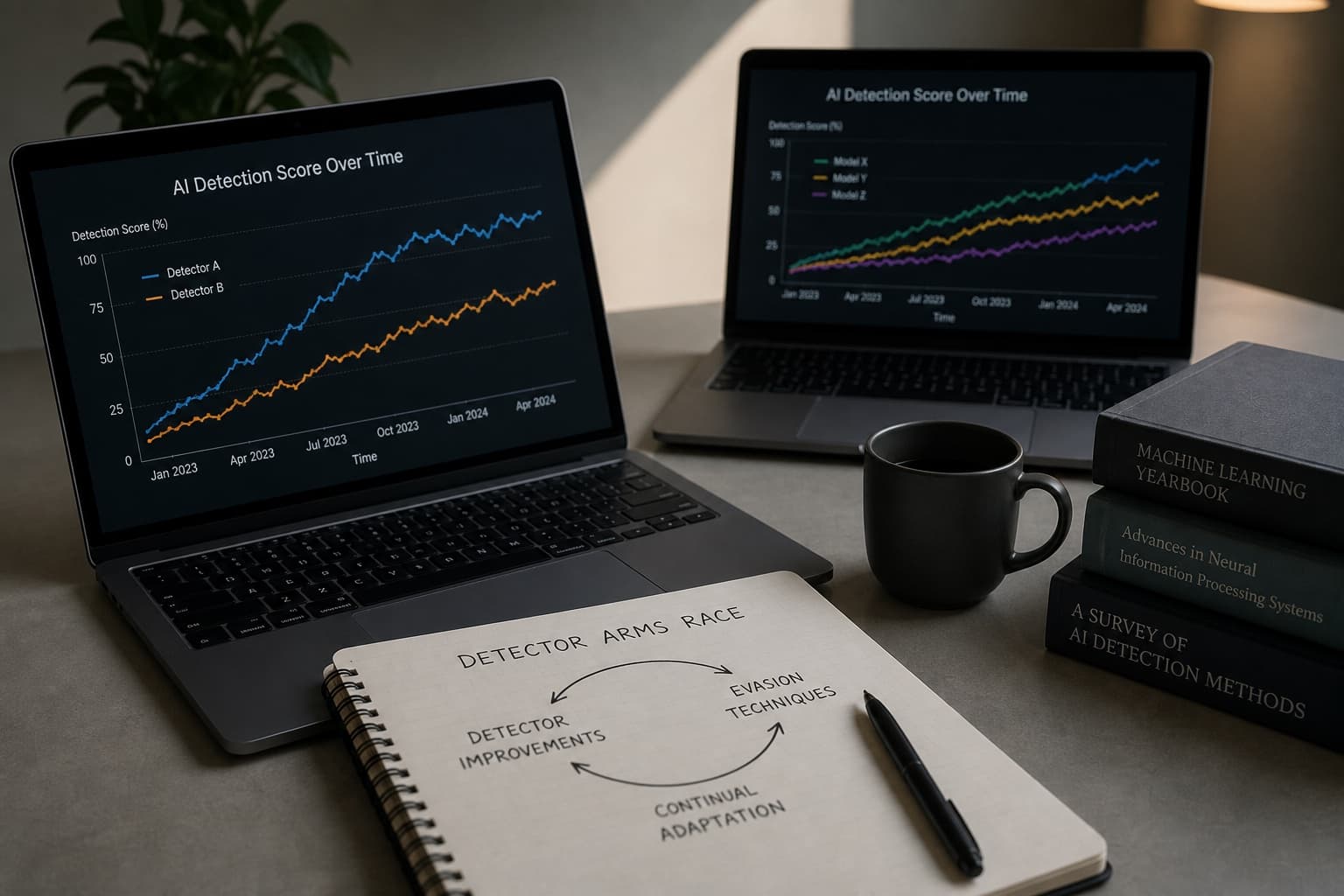
Detector scores move. So do humanizer outputs. That is not a bug in one vendor—it is what happens when generators, editors, and classifiers all update on different calendars. Marketing that promises "100% undetectable" text ignores how statistical detectors and retrained models behave in the wild.
Human Writes is a voice and clarity pass on writing you already own. It is not a bypass product, not a stealth layer, and not a guarantee about any third-party score.
Related: Turnitin AI detection guide, GPTZero classroom guide, Copyleaks detector guide, Originality AI detector guide, AI detection false positives, future of AI detection.
What the arms race actually is
Three loops run at once:
| Loop | What changes | Effect on you |
|---|---|---|
| Generator releases | New models, APIs, default styles | Yesterday's "AI tell" may fade; new tells appear |
| Detector retraining | Vendors ingest new corpora | Scores drift on unchanged text |
| Human edit passes | You, Human Writes, or a line editor | Mixed authorship—detectors disagree more |
None of these loops promises a stable "pass" line. A score is a snapshot from one model on one day.
For how Turnitin splits similarity vs AI writing, see Turnitin's guide. For teacher-side GPTZero workflows (not student bypass), see GPTZero in the classroom.
Why the same paragraph scores differently
Common reasons—without any "stealth" claim:
Different detectors, different labels. Copyleaks, Originality, GPTZero, and Turnitin use overlapping but not identical signals. Compare products in Copyleaks vs Originality—expect disagreement.
Edits change statistics, not authorship truth. Shorter sentences, swapped transitions, and human examples alter predictability scores. That does not mean the text is "safe" or "unsafe"—it means the classifier saw different patterns.
ESL and formal prose. Highly structured academic English triggers false positives for some tools. Documented in AI detection false positives.
Vendor updates. A silent model refresh can move thresholds. Re-running the same file next week is normal research practice, not proof of evasion.
Quoted and templated blocks. Methods sections, rubric language, and boilerplate read synthetic next to personal narrative.
Human Writes targets awkward AI cadence after your facts are locked. It does not optimize against a specific detector's weights—that is an arms race we do not sell.
Before and after (voice, not "beating" a score)
Stiff AI draft:
Furthermore, it is important to note that effective communication plays a crucial role in organizational success. Moreover, stakeholders must be aligned to ensure optimal outcomes across diverse teams.
After fact-owned rewrite + one Human Writes pass:
Last quarter's rollout failed once—in a handoff email, not in the spec. This quarter we put the cutover table in the subject line and pinned the same dates in Slack. Tickets dropped because people knew what changed Friday, not because we hid the change.
The second version is clearer human work. Do not infer a detector percentage from that swap. Run your institution's policy, not a free tool lottery.
A honest workflow when detectors matter
- Write from your sources—notes, data, incidents—not "generate essay."
- Lock facts tables, dates, citations before any polish pass.
- One Human Writes pass on voice if prose sounds templated.
- Re-read for accuracy—humanizers must not change meaning.
- If your school uses Turnitin—understand similarity vs AI before upload.
- If a score triggers review—use false-positive appeal guidance where applicable; bring drafts and process proof.
- Disclose AI use when honor codes require it—polish tools may still count.
For publishers and agencies choosing detectors, see Copyleaks and Originality guides—pick process, not a magic threshold.
Myths we do not endorse
| Myth | Reality |
|---|---|
| "Humanize until GPTZero says 0%" | Scores move; optimizing for one tool is fragile |
| "Undetectable rewrite" | No ethical vendor guarantees invisibility |
| "Paraphrase equals human" | Paraphrasers vs humanizers—different job |
| "One free scan = verdict" | Signal, not proof—context matters |
| "Detectors are useless" | Noisy, but institutions still use them—know your policy |
Category posts like future of AI detection argue detection persists alongside process proof (drafts, oral defense, portfolios)—not that scores disappear.
What Human Writes is for
- You drafted from your outline and the prose sounds flat or templated.
- You need readable rhythm without inventing facts.
- You want a single editing pass before submission—not a detector war.
What it is not:
- A bypass or "stealth writer" replacement (myth posts cover why that marketing fails).
- A substitute for your analysis, clinical scenes, or cutover dates.
- Legal or academic policy advice—follow your handbook.
Bottom line
Scores move because models, detectors, and edits co-evolve. Treat percentages as noisy signals; own your workflow and disclosures. Human Writes helps you sound like yourself on work you wrote—it does not promise undetectable output.
Edit your draft on Human Writes when the facts are yours and you want a clarity pass—not a stealth guarantee.